
Researched by Hafsa Research and Analysis Company
1. The big picture: Why this tension matters more than ever
In today’s high-velocity business environment – changing technology, geopolitical uncertainty, booming valuations, inflationary pressure – companies face a dual challenge: grow fast and innovatively, while simultaneously maintaining financial discipline and resilience.
- The role of the Chief Executive Officer (CEO) is increasingly tied to growth ambition: market expansion, new business models, disrupt or be disrupted.
- The role of the Chief Financial Officer (CFO) is evolving beyond “number-watching” into strategic partner: safeguarding capital, modelling risk, enabling sustainable scale. PwC+2Wise+2
- The intersection of these roles is where many of the biggest strategic decisions occur, and many of the biggest failures too. For example: a study found only ~8% of CFOs-turned-CEOs reached top-quartile performance, partly because they did well on margin discipline but lagged on growth. spencerstuart.com+1
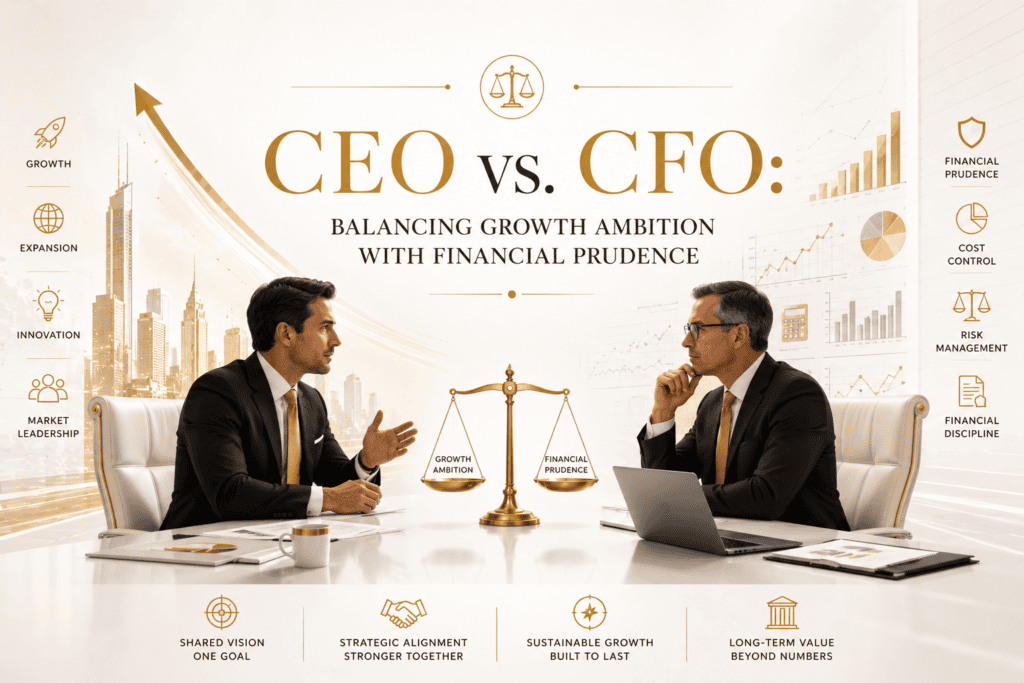
Thus, the question isn’t “Who is more important?” but how the CEO and CFO work together, and how an organisation balances growth ambition with financial prudence.
2. Key strategic themes: What successful organisations get right
- Vision vs. Realities: The CEO sets the vision, the CFO translates into financial strategy and constraints. One cannot work in isolation. Wise+1
- Risk & Reward Spectrum: Growth often requires risk (new markets, products, business models). The CFO ensures those risks are understood, modelled and financed appropriately. FasterCapital
- Metrics & Mindsets: CEOs often track forward-looking indicators (market share, revenue growth, innovation pipeline). CFOs often track health indicators (cash flow, margins, debt levels). Wise+1
- Governance & Alignment: The CEO-CFO partnership must be built on mutual respect, transparency and shared strategic language. Without it, growth may outpace control, or discipline may choke innovation. Northwest Executive Education
- Stage of Company Matters: In turnaround or heavy M&A situations, a CFO-type CEO may be beneficial. In high growth, innovation-driven phases, a growth-oriented CEO is often required. McKinsey & Company
3. Real-life examples: Successes & cautionary tales
Example A – A CFO-turned-CEO Struggle
According to research from Spencer Stuart, CEOs who were formerly CFOs achieved higher profitability in early years but struggled with top-line growth compared to peers, which limited their long-term outperformance. spencerstuart.com
Key takeaway: financial prudence is valuable, but insufficient if the growth engine remains weak.
Example B – Growth-CEO with Weak Financial Controls
Consider companies that aggressively expand without robust financial governance: they may grow fast, but run into liquidity‐crisis, cost overruns, integration failures. The CFO’s role in such cases becomes critical to stabilise and sustain. (Generalised from multiple sources)
Example C – Balanced CEO & CFO Partnership
In companies where CEOs and CFOs are tightly aligned – the CEO driving ambition, the CFO guarding sustainability – you see high growth and strong balance-sheet health. For instance, newer studies show CFOs increasingly assuming strategic roles in growth and transformation. EXEC Capital Recruitment+1
4. Implications & Practical Take-aways for You (and the enterprises you advise)
Given your expertise in M&A, real-estate development, and working with family businesses, these are tailored insights:
- For the CEO role (or family business principal/growth owner):
- Be ambitious: pursue growth, new markets, partnerships, innovation.
- But don’t dismiss financial signals: ensure you have the right CFO or financial advisor modelling risk, cash flow, scenario analysis.
- Work with your CFO: jointly review strategic options with financial modelling up front (you’re already strong here).
- For the CFO role (or you advising as consultant):
- Move beyond just financial reporting: engage in scenario planning, growth modelling, risk assessment of new ventures.
- Build the language of growth: understand not just cost, but value-creation, market potential, competitive dynamics.
- Align with the CEO: ensure you speak the same strategic language so you’re on board with ambition, not just holding it back.
- For the organisation/board/advisory framework:
- Have clarity on “Who leads growth?”, “Who ensures sustainability?” but also “How do they partner?”
- Set joint KPIs: e.g., revenue growth + margin expansion + cash-flow targets.
- Ensure stage-appropriate leadership: If you’re in rapid expansion (e.g., cross-border real estate roll-out), ensure the CFO is equipped and the CEO has growth experience.
- For your consultancy focus:
- You can position yourself as the bridge: you understand valuation, financial modelling, due diligence (CFO side) + you understand growth strategy, market entry, expansion (CEO/growth side).
- In family business/real-estate context: help define the roles of the family principal (CEO) vs the finance leader (CFO) vs the board/advisory committee.
- Model scenarios: e.g., new project acquisition, capital raise, joint venture across borders — simulate growth vs risk vs return, and show how CFO/CEO alignment drives value.
5. Where caution is required (and what to watch out for)
- A CFO who becomes CEO may lean too heavily on financial discipline and under-invest in growth: the Spencer Stuart study found only ~8% reached top-quartile performance. spencerstuart.com+1
- A CEO without CFO discipline risks over-extension: rapid growth can bring liquidity crunches, unsustainable cost structures, weak margins.
- Things get trickier in family-business settings: roles may be blurred (the family principal acts as CEO, but also expects CFO control) — clarity and role definition are essential.
- The growth vs prudence balance shifts with business stage: early startup vs large mature business vs turnaround require different emphasis.
✅ Summary
The interplay between the CEO and CFO roles is one of the most critical in any organisation – especially when growth ambition meets financial prudence. For a firm to truly excel, it must not choose one side exclusively; it must integrate both. With your skills and advisory lens, you’re in a strong position to guide organisations — especially family-businesses and real-estate growth ventures — to strike that balance and scale responsibly.
Researched by Hafsa Research and Analysis Company