
Founder and President of Hafsa Advisors and Solutions LLP
The 40-Hour Business Problem
Most businesses today operate under layers of inefficiency — outdated reporting systems, manual approvals, and unstructured data flows.
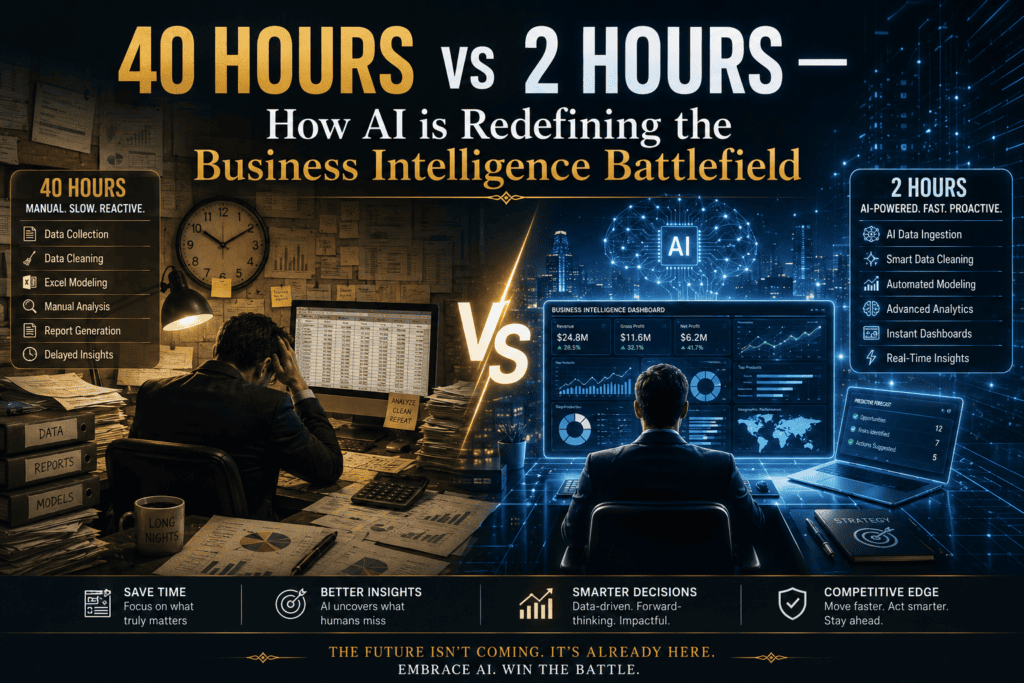
It’s not uncommon for management teams to spend 40+ hours reconciling reports, verifying accounts, or manually tracking KPIs that could be identified in under 2 hours with intelligent automation.
Here’s what we often uncover when conducting a full-spectrum business analysis:
Financial & Operational Findings
- Non-standardized Accounting Practices — Reports differ across departments, creating inconsistent financial visibility.
- Overstated Revenues or Receivables — No real-time aging analysis or provisioning.
- Inefficient Asset Management — Machinery, vehicles, and equipment not monitored for depreciation or utilization.
- Weak Cost Controls — No clear link between spending and value creation.
- Data Silos — Each function maintains its own data universe, blocking enterprise-wide insight.
- Manual Audit Trails — Hours wasted tracing back transactions without automated workflows.
Governance & Policy Findings
- No Delegation of Authority Framework — Unclear accountability in financial and operational approvals.
- Policy Absence or Redundancy — Procurement, HR, and payment cycles often run without policy guidance.
- Risk Management Gaps — No central register to track, quantify, or prioritize business risks.
- Vendor Dependencies — Over-reliance on single suppliers or consultants without periodic review.
Digital & Strategic Findings
- Outdated ERP or No ERP Integration — Systems fail to talk to each other, resulting in poor analytics.
- Underutilized Data Assets — Customer and transaction data not recognized as strategic assets.
- No AI or Automation Deployment — Repetitive manual work eats strategic time.
- No Business Intelligence Layer — Lack of dashboards, visualization, and real-time insight for decision-making.
- Reactive Culture — Teams respond to crises rather than predict and prevent them.
The 2-Hour Revolution — AI as the Business Multiplier
Artificial Intelligence isn’t a futuristic tool anymore — it’s a competitive necessity.
When properly integrated, AI can cut through legacy inefficiencies and turn a 40-hour process into a 2-hour transformation.
AI can now:
- Map financial and operational gaps in real time.
- Detect anomalies in expenses, procurement, and revenue recognition.
- Predict liquidity stress or risk clusters before they materialize.
- Automate compliance and reporting, ensuring every report is governance-ready.
- Transform static data into actionable insights for strategic growth.
This isn’t just about saving time — it’s about creating business intelligence that self-corrects.
From Reactive to Predictive Governance
Traditional businesses rely on reports after results are out.
AI-driven businesses, however, monitor live signals to act before impact.
That’s the difference between:
- Finding a loss and preventing it.
- Reporting a deviation and predicting one.
- Explaining performance and engineering performance.
This shift from reactive to predictive is the new hallmark of sustainable enterprises.
The Human Element Still Reigns
AI brings precision, but wisdom still belongs to humans.
Strategy, ethics, and leadership are not programmable.
AI can forecast, but only leadership can decide.
And when both work in harmony, the organization becomes self-aware, efficient, and future-proof.
Final Reflection
If your business operations were analyzed by AI today — would it expose inefficiency or excellence?
The businesses of tomorrow will not be defined by how much they work —
but by how intelligently they operate.
Signature & Mission
President and Founder Hafsa Advisors and Solutions LLP
Mission: Architecting legacy-grade financial intelligence, valuation logic, and dynastic governance.