
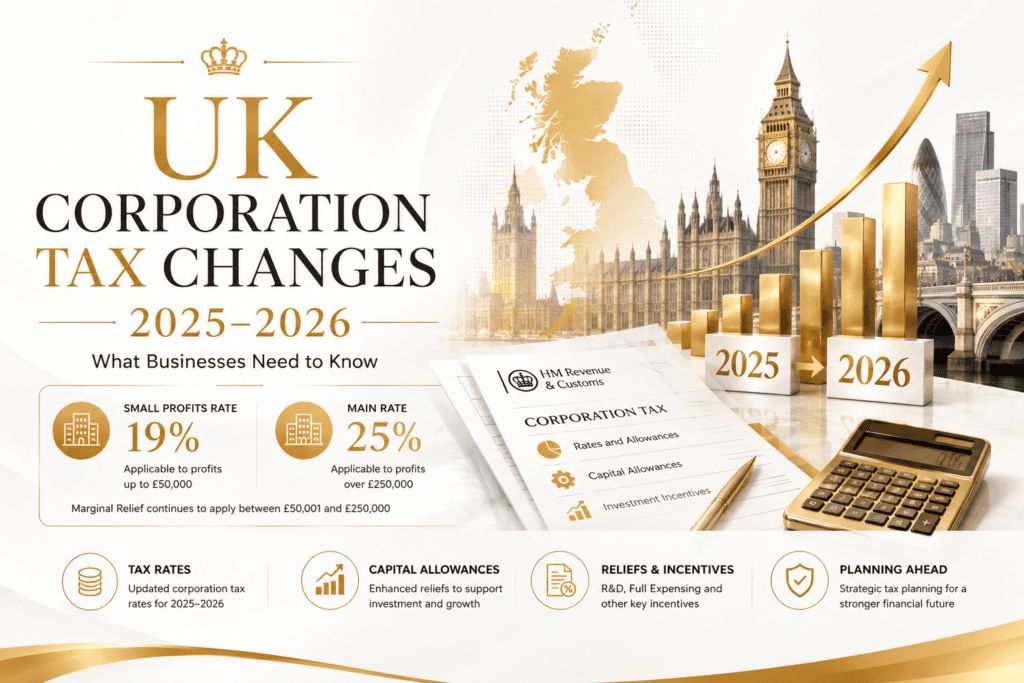

The years 2025–2026 are expected to bring some of the most significant changes to the UK tax system in recent years. The UK government has introduced adjustments to tax thresholds, dividend taxation, capital allowances, and corporate interest restriction rules, while also aligning parts of the system with global tax reforms such as the OECD Two-Pillar framework.
For UK-based SMEs, multinational corporations, finance directors, finance managers, and owner-directors, understanding these changes is essential. Errors in tax planning or compliance could lead to increased liabilities, penalties, and reduced profitability.
Types of Changes in UK Corporation Tax
Personal Allowance
The Personal Allowance has been fixed at £12,570 for the tax years up to 2028–2029 and is expected to remain frozen until 2030–2031.
Impact
- Increases disposable income for employees.
- Boosts consumer spending on goods and services.
- Improves employee morale and purchasing power.
Basic Rate Limit
The Basic Rate Limit has been maintained at £37,700 for the same period.
Impact
- Encourages employees to work more without immediately entering higher tax bands.
- Supports middle-class spending power.
- Helps businesses maintain stable consumer demand.
Higher Rate Band Threshold
The Higher Rate Threshold remains at £50,270.
Impact
- Leaves skilled professionals with more disposable income.
- Encourages entrepreneurship and productivity.
- Helps businesses attract and retain talented employees.
Income Tax Calculation Rules
New income tax calculation rules are expected to take effect from 6 April 2027.
Impact
- Improves transparency and financial planning.
- Helps businesses forecast labour costs more accurately.
- Simplified tax systems may reduce compliance costs.
Property Income Tax Rates
New property income tax rates are expected for the 2027–2028 tax year:
- Basic Rate: 22%
- Higher Rate: 42%
- Additional Rate: 47%
Impact
- Encourages accurate reporting of rental income.
- Generates additional government revenue.
- Supports professional property management industries.
Capital Allowances
A new 40% First-Year Allowance will apply to qualifying expenditure incurred from January 2026.
Impact
- Encourages investment in machinery, technology, and innovation.
- Supports automation and digital transformation.
- Improves productivity and efficiency.
- Helps startups and SMEs reduce taxable profits.
Corporate Interest Restriction (CIR)
Technical amendments to the CIR regime will be introduced, including relief for certain capital restrictions.
Impact
- Reduces aggressive tax avoidance strategies.
- Promotes fairer competition among businesses.
- Encourages stronger financial structures and responsible borrowing.
Impact of These Changes on Worldwide Businesses
The UK remains one of the world’s leading financial and commercial centres. Therefore, changes in its corporate tax system can influence international investment decisions and global business operations.
Key Effects on Businesses
- Increased need for strategic tax planning.
- Greater reliance on digital accounting and compliance systems.
- Higher demand for tax consultants and financial advisors.
- More focus on international tax transparency and governance.
- Potential changes in foreign direct investment decisions.
Multinational companies may also need to restructure financing arrangements and reassess investment strategies to remain tax-efficient under the evolving rules.
Tax Consultant Comments
Well-known UK tax professionals have expressed concerns regarding the complexity of the UK corporate tax system.
- Tax expert Dan Neidle stated that the UK corporation tax system is “one of the least competitive in the world” because of its complexity. He suggested that simplifying corporate tax rules would encourage growth and investment.
- Colin Graham, Head of Tax Policy at PwC UK, commented that businesses need “stability and certainty” in UK tax policy. He also warned that frequent changes and complicated regulations increase compliance challenges for companies.
Conclusion
The UK corporation tax changes for 2025–2026 represent a major shift in taxation policy and business regulation. These reforms aim to improve tax transparency, encourage investment, and strengthen the government’s revenue system. Measures such as enhanced capital allowances and revised income tax structures may support economic growth and innovation.
However, increasing complexity in corporate tax rules and ongoing regulatory changes may also create challenges for businesses, particularly SMEs and multinational organizations. Companies must therefore strengthen their financial planning, compliance systems, and professional tax advisory support to remain competitive in an evolving global business environment.