
Introduction
Sustainability has become one of the defining priorities of modern business. Consumers, investors, lenders, regulators, and other stakeholders increasingly expect organizations to operate responsibly while minimizing their environmental impact. As Environmental, Social, and Governance (ESG) principles continue to shape global business practices, companies are investing heavily in sustainable products, renewable energy, ethical supply chains, and transparent corporate governance.
Consumer preferences have also evolved significantly. Many customers now actively choose environmentally friendly products and are willing to pay a premium for businesses that demonstrate genuine sustainability commitments. Similarly, banks and financial institutions are increasingly linking financing decisions to ESG performance through sustainability-linked loans, green bonds, and ESG-linked financial instruments.
To enhance transparency and comparability in sustainability reporting, the International Sustainability Standards Board (ISSB) introduced IFRS S1 – General Requirements for Disclosure of Sustainability-related Financial Information and IFRS S2 – Climate-related Disclosures, providing organizations with globally recognized reporting standards.
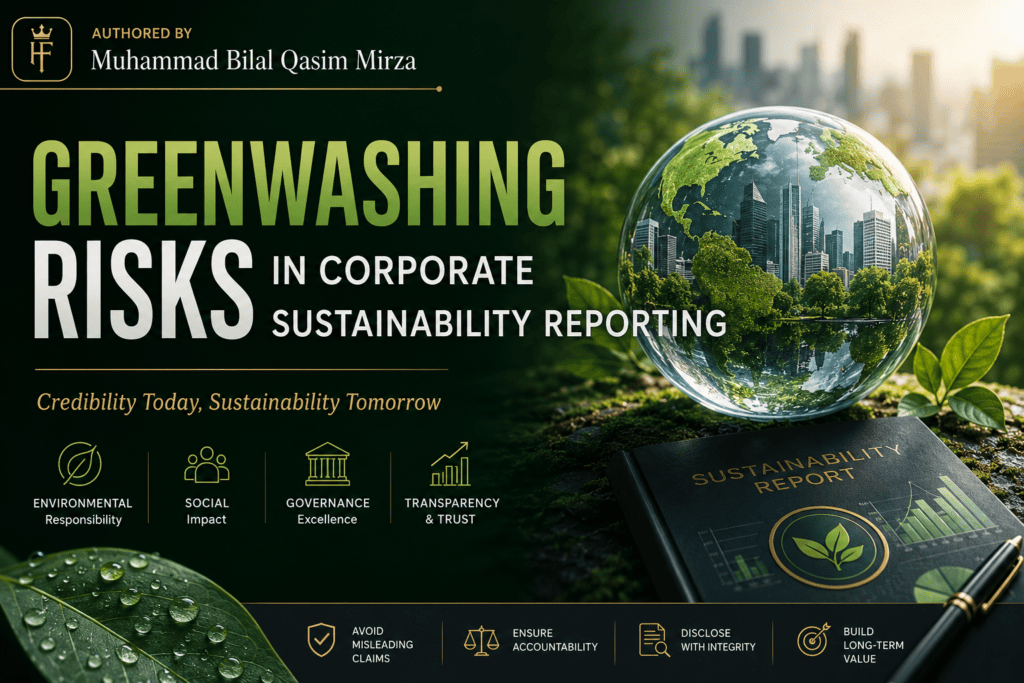
However, alongside this growing emphasis on sustainability has emerged a significant corporate risk, greenwashing.
What is Greenwashing?
Greenwashing refers to the practice of misleading stakeholders by exaggerating, overstating, or falsely presenting a company’s environmental or sustainability achievements. Instead of implementing meaningful sustainability initiatives, some organizations rely on aggressive marketing campaigns and selective disclosures to create the appearance of being environmentally responsible.
Examples of greenwashing include:
- Claiming products are “100% eco-friendly” without credible evidence.
- Publishing selective environmental data while omitting significant negative impacts.
- Using vague marketing terms such as green, natural, or environmentally safe without substantiation.
- Announcing ambitious net-zero commitments without a realistic implementation strategy.
- Highlighting minor sustainability initiatives while ignoring major sources of pollution or emissions.
Such practices undermine stakeholder confidence and distort informed decision-making.
Why Greenwashing is Increasing
Several factors have contributed to the rise of greenwashing globally:
- Growing consumer demand for sustainable products.
- Increased investor focus on ESG performance.
- Expansion of sustainable finance and ESG-linked lending.
- Competitive pressure to enhance corporate reputation.
- Greater public awareness of climate change and environmental protection.
- Marketing strategies designed to capitalize on sustainability trends.
As sustainability becomes a competitive advantage, some organizations attempt to gain reputational benefits without making meaningful operational changes.
Impact on Businesses
Greenwashing may provide short-term marketing benefits, but its long-term consequences can be severe.
1. Loss of Consumer Trust
Once misleading environmental claims are exposed, customers often lose confidence in the brand, leading to declining sales and damaged reputation.
2. Reputational Damage
Corporate reputation is one of an organization’s most valuable intangible assets. Allegations of greenwashing can significantly damage public perception and brand value.
3. Regulatory Investigations
Many jurisdictions are strengthening regulations against misleading environmental claims. Companies may face investigations, penalties, fines, or mandatory corrections to their sustainability disclosures.
4. Legal Risks
Investors, consumer protection agencies, shareholders, and advocacy groups are increasingly initiating legal actions against organizations accused of deceptive ESG reporting
5. Financial Consequences
Greenwashing can reduce market valuation, increase the cost of capital, discourage institutional investment, and negatively affect long-term profitability.
How Investors View Greenwashing
Institutional investors are placing greater emphasis on credible sustainability reporting when making investment decisions. Rather than relying solely on marketing claims, investors increasingly assess whether ESG commitments are supported by measurable performance, transparent disclosures, and effective governance.
Investors generally evaluate:
- Climate-related risks and opportunities.
- Carbon emission reduction strategies.
- Board oversight of sustainability matters.
- ESG governance frameworks.
- Independent assurance over sustainability reports.
- Compliance with international reporting standards.
When companies are found to have overstated their sustainability performance, investors may reduce their holdings, withdraw funding, or demand stronger governance reforms. Greenwashing can therefore increase both investment risk and the company’s cost of capital.
The Role of IFRS Sustainability Standards
The introduction of IFRS S1 and IFRS S2 represents a major step toward improving the consistency and reliability of sustainability reporting.
These standards encourage organizations to disclose:
- Sustainability-related risks and opportunities.
- Climate-related financial impacts.
- Governance responsibilities.
- Risk management processes.
- Strategy and resilience assessments.
- Quantitative performance metrics and targets.
By adopting these standards, companies can enhance transparency, improve comparability across industries, and strengthen stakeholder confidence.
Governance: The First Line of Defense
Strong corporate governance plays a critical role in preventing greenwashing.
Organizations should establish:
- Board-level oversight of ESG initiatives.
- Clear sustainability policies and objectives.
- Internal controls over ESG reporting.
- Independent verification and assurance of sustainability information.
- Reliable data collection and monitoring systems.
Ethical corporate culture supported by accountability.
Effective governance ensures sustainability reporting reflects actual operational performance rather than marketing ambitions.
Best Practices to Prevent Greenwashing
Organizations can reduce greenwashing risks by adopting the following practices:
- Base sustainability claims on verifiable evidence.
- Align disclosures with IFRS S1 and IFRS S2 requirements.
- Obtain independent assurance over sustainability reports where appropriate.
- Report both achievements and ongoing challenges transparently.
- Establish measurable ESG performance indicators.
- Ensure consistency between sustainability reports, annual reports, and corporate communications.
- Train management and employees on ethical ESG reporting practices.
- Continuously monitor compliance with evolving sustainability regulations.
The Future of Sustainability Reporting
As global sustainability regulations continue to evolve, organizations will face increasing expectations for transparency, accountability, and reliable ESG disclosures.
Artificial intelligence, advanced data analytics, digital reporting platforms, and enhanced assurance procedures are expected to improve the quality and credibility of sustainability reporting. At the same time, regulators worldwide are strengthening enforcement against misleading environmental claims.
Companies that embrace authentic sustainability practices will be better positioned to attract investment, build customer loyalty, access sustainable financing, and create long-term value. Conversely, organizations engaging in greenwashing may face increasing legal, financial, and reputational risks.
Closing Thoughts
Greenwashing is no longer merely a reputational concern, it has become a significant governance, financial reporting, and strategic risk. As stakeholders demand greater transparency and accountability, organizations must ensure that sustainability reporting accurately reflects genuine environmental and social performance rather than aspirational marketing narratives.
The adoption of internationally recognized reporting frameworks such as IFRS S1 and IFRS S2, supported by strong corporate governance and ethical leadership, enables companies to build lasting stakeholder trust while contributing meaningfully to sustainable economic development.
Ultimately, credibility is becoming one of the most valuable assets in corporate sustainability reporting. Organizations that prioritize honesty, transparency, and measurable ESG performance will not only comply with evolving regulatory expectations but will also strengthen investor confidence, enhance corporate reputation, and secure long-term competitive advantage.