

By Mirza
Founder & President, Hafsa Advisors and Solutions LLP
Executive Insight
The modern business does not necessarily suffer from a lack of data.
It suffers from the inability to convert data into decisions quickly enough.
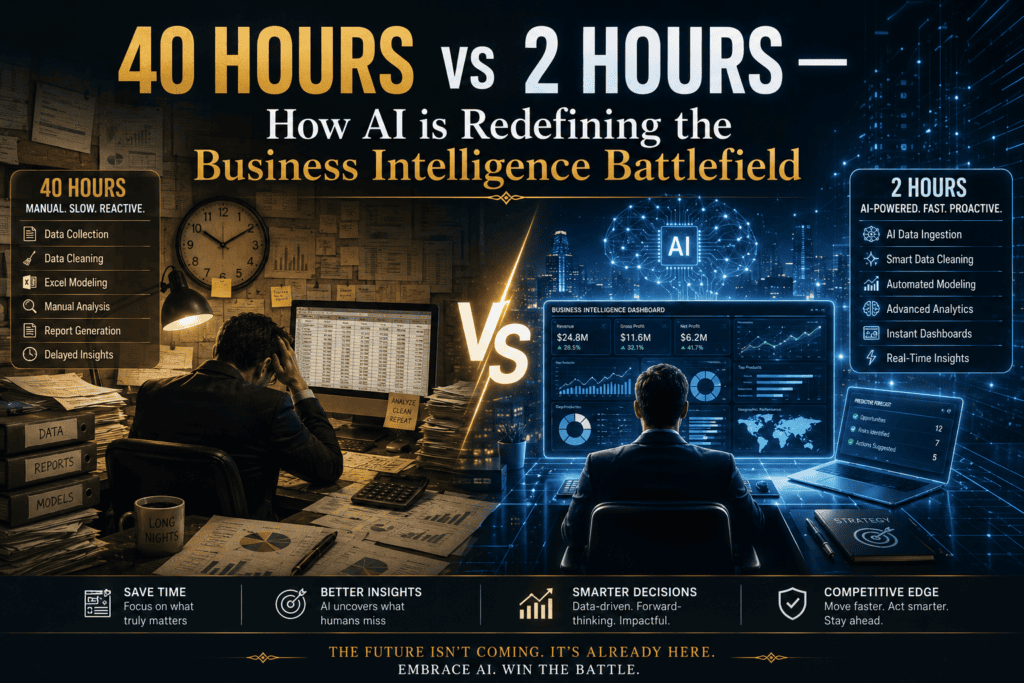
A management team may spend 40 hours collecting spreadsheets, reconciling figures, investigating variances and preparing reports—only to discover that the resulting information is already outdated.
The opportunity is no longer simply to work harder.
It is to redesign how intelligence moves through the organisation.
The objective should be simple:Turn 40 hours of manual analysis into 2 hours of decision-ready intelligence.
1. Find the 40-Hour Problem First
Before implementing AI, management should identify where time and information are being lost.
A practical diagnostic should examine five areas:
Finance: reconciliations, month-end reporting, receivables, budgeting and variance analysis.
Operations: procurement, inventory, asset utilisation and workflow approvals.
Governance: delegation of authority, policies, controls and audit trails.
Technology: ERP integration, data quality, reporting infrastructure and system duplication.
Strategy: forecasting, scenario analysis, customer intelligence and risk monitoring.
The objective is not to automate everything.
It is to identify the highest-value processes where automation can simultaneously reduce time, improve accuracy and strengthen control.
2. Build an AI Opportunity Map
Every repetitive process should be assessed against four questions:
How much time does it consume?
How frequently does it occur?
How much financial or operational risk does it contain?
Can the underlying data be accessed reliably?
This creates an AI Opportunity Score.
For example:
| Process | Time | Risk | AI Potential |
| Management reporting | High | High | Very High |
| Invoice review | High | Medium | High |
| KPI monitoring | High | High | Very High |
| Strategic decisions | Medium | Very High | Decision support |
| Policy interpretation | Medium | High | High |
The result is a prioritised roadmap rather than an expensive technology experiment.
3. Create the 2-Hour Intelligence Engine
A high-value AI transformation should connect four layers:
Data → Intelligence → Action → Governance
Data: ERP, accounting, CRM, procurement, HR and operational systems.
Intelligence: AI identifies patterns, anomalies, trends and emerging risks.
Action: Management receives recommendations, alerts and prioritised exceptions.
Governance: Every material decision remains traceable, reviewable and accountable.
This is where AI becomes more than a chatbot.
It becomes an intelligence layer across the enterprise.
4. Automate the Exception—Not Just the Process
One of the biggest opportunities for CFOs is moving from reviewing everything to reviewing what matters.
Instead of manually checking thousands of transactions, AI can help identify exceptions such as:
- Unusual expense patterns
- Duplicate transactions
- Unexpected supplier price movements
- Receivables deterioration
- Unusual journal entries
- Margin compression
- Inventory anomalies
- Unusual purchasing behaviour
Management can then operate through an exception-based control model.
Normal transactions flow through efficiently.
Exceptions receive human attention.
The objective:
Less time checking normal activity.
More time investigating meaningful risk.
5. Move From Reactive to Predictive Finance
Traditional reporting tells management what happened.
Advanced analytics can help explain why it happened and identify what may happen next.
A CFO dashboard should therefore progress through three questions:
Past: What happened?
Present: What is happening now?
Future: What is likely to happen next?
For example, rather than reporting that receivables increased by 15%, an intelligent system could identify:
Receivables ↑ → overdue concentration ↑ → customer risk ↑ → projected cash-flow pressure ↑
That converts reporting into decision support.
6. Protect the Business From “Bad AI”
AI transformation without governance creates a new category of risk.
Management should establish controls covering:
Data quality: Is the underlying information reliable?
Access: Who can use sensitive financial and customer data?
Model oversight: How are AI outputs validated?
Human approval: Which decisions require management sign-off?
Auditability: Can the organisation explain how a recommendation was generated?
Cybersecurity: Can sensitive information be exposed through inappropriate AI usage?
AI should therefore operate under a simple principle:
AI recommends. Humans remain accountable.
7. The CFO’s 90-Day AI Transformation Plan
Days 1–30: Diagnose
Map major processes, quantify hours consumed, identify data sources and calculate the financial impact of inefficiencies.
Days 31–60: Prioritise
Select three to five high-value use cases based on:
Time saved + risk reduction + financial impact + implementation feasibility.
Days 61–90: Deploy
Build dashboards, automate selected workflows, establish exception alerts and introduce management reporting.At the end of 90 days, management should be able to demonstrate measurable outcomes—not simply claim that it has “adopted AI.”
8. Measure the Return on Intelligence
AI investment should be evaluated like any other business investment.
Track:
Hours eliminated
Reporting cycle-time reduction
Error reduction
Control exceptions detected
Cash-flow improvement
Revenue opportunities identified
Risk events prevented
Employee capacity released
The most important metric may ultimately be:
Management Hours Released for Strategic Decision-Making
If AI saves 10,000 hours annually but creates no better decisions, the transformation is incomplete.
If those 10,000 hours are redirected toward pricing, capital allocation, customer strategy, risk management and growth, AI has created genuine enterprise value.
The 2-Hour Executive Test
Ask your organisation to select one critical management report.
Then measure:
How long does it take to collect the data?
How many people touch it?
How many spreadsheets are involved?
How many manual reconciliations occur?
How long does management wait for answers?
How quickly can the organisation identify the exceptions?
If the answer is measured in days rather than hours, there is probably an intelligence transformation opportunity.
Final Reflection
The competitive advantage of AI will not belong to organisations that simply purchase the most sophisticated technology.
It will belong to organisations that redesign decision-making around intelligence.
The winning architecture is:
40 Hours → Data Collection
2 Hours → Intelligent Analysis
Minutes → Executive Action
AI should not replace leadership.
It should eliminate the unnecessary work that prevents leadership from thinking.
The future enterprise will therefore not be defined by how much data it possesses.
It will be defined by how quickly it can transform information into controlled, intelligent action.
The question for every CEO and CFO is no longer:
“Should we use AI?”
It is: “Which 40-hour process should we eliminate first?”
Mirza
Chief Research officer
Hafsa Research and Analysis company
Mission: Architecting legacy-grade financial intelligence, valuation logic, and dynastic governance.