
Prepared by Hafsa Research and Analysis Company
Turning Risk Frameworks into a Strategic Advantage
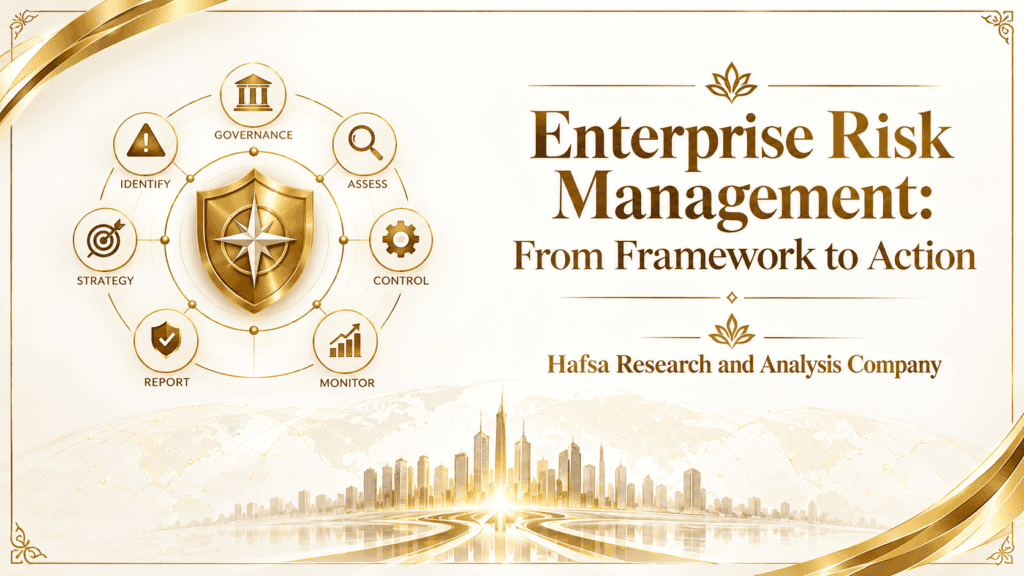
Enterprise Risk Management (ERM) is often treated as a framework, risk register, or compliance requirement. In practice, its real value comes from something much more important: how effectively an organization converts risk information into better decisions.
Organizations today face interconnected financial, operational, strategic, technology, cyber, regulatory, ESG, and reputational risks. A documented framework alone cannot protect an organization from these uncertainties. The solution is to embed risk management into strategy, operations, performance management, and leadership decisions.
The Core Problem: ERM Without Execution
Organizations may have sophisticated ERM frameworks but still experience significant failures when:
- Risk registers are updated only for compliance purposes.
- Senior management does not actively challenge risk assumptions.
- Risk ownership is unclear.
- Emerging risks are not monitored continuously.
- Risk information does not reach decision-makers at the right time.
- Internal audit, compliance, finance, and operational teams work in silos.
- Employees are discouraged from escalating problems.
The central solution is therefore not simply adopting another framework—it is improving the organization’s risk management operating model.
Solution 1: Align Risk With Business Strategy
ERM should begin with the organization’s strategic objectives.
For every major objective, management should ask:
What could prevent us from achieving this objective?
For example, a company planning international expansion should assess foreign exchange exposure, taxation, regulatory requirements, supply-chain dependency, cybersecurity, political and geopolitical uncertainty, financing requirements, and reputational risks.
This creates a direct connection between strategy → risk → controls → performance.
Solution 2: Establish Clear Risk Ownership
Every significant risk should have a clearly identified owner.
A practical risk ownership structure can include:
Board: Oversight and risk appetite
CEO: Strategic accountability
CFO: Financial and reporting risks
CRO/Risk Function: ERM coordination and monitoring
Business Units: Operational risk ownership
Internal Audit: Independent assurance
This prevents the common problem where everyone is “responsible” for risk but nobody is actually accountable.
Solution 3: Build a Dynamic Risk Dashboard
Traditional risk registers can become outdated quickly. Organizations should supplement them with dashboards showing:
- Top enterprise risks
- Risk appetite versus actual exposure
- Key Risk Indicators (KRIs)
- Control weaknesses
- Emerging risks
- Risk trends
- Significant incidents
- Management actions and deadlines
Management should receive concise information that supports decisions rather than large volumes of disconnected risk data.
Solution 4: Integrate ERM With GRC, Internal Audit and Compliance
Risk management becomes stronger when functions communicate rather than operate independently.
Organizations can create an integrated model connecting:
Governance + Risk + Compliance + Internal Audit + Finance + Strategy
This reduces duplication, identifies control gaps, improves accountability, and provides management with a more complete view of organizational exposure.
Solution 5: Move From Annual Risk Assessment to Continuous Monitoring
Risk assessment should not be a once-a-year exercise.
Management should establish regular monitoring for material risks and trigger immediate reassessment when there are major changes such as:
- New regulations
- Acquisitions or disposals
- Major technology implementation
- Cyber incidents
- Significant market movements
- Supply-chain disruption
- New geographic expansion
- Material financial deterioration
A dynamic approach allows organizations to respond before risks become crises.
Solution 6: Build a Risk-Aware Culture
The strongest ERM framework can fail if employees are afraid to report problems.
Organizations should encourage constructive challenge, escalation, transparency, and accountability. Senior leadership must demonstrate that identifying a risk is not a failure—it is an important part of protecting the organization.
Executive ERM Diagnostic
Management can test the maturity of its ERM system by asking:
Can we identify our five most significant enterprise risks today?
Do we know who owns each risk?
Can we quantify or reasonably assess our exposure?
Are our risks connected to strategic objectives?
Do our KRIs provide early warning?
Does the Board receive decision-useful risk information?
Can employees escalate emerging risks without unnecessary barriers?
If several answers are “No,” the organization may have an ERM framework—but not yet an effective ERM system.
The Hafsa Solution
At Hafsa Research and Analysis Company, ERM should be approached as a solution-driven discipline rather than a documentation exercise.
Our solution-based ERM newsletter can help organizations assess their existing framework, identify risk and control gaps, evaluate risk maturity, strengthen risk ownership, develop KRIs and dashboards, integrate risk with strategy, and establish practical monitoring mechanisms.
The objective is straightforward:
Identify risks earlier. Understand their potential impact. Assign accountability. Strengthen controls. Improve decisions.
Final Insight
The question for organizations should no longer be:
“Do we have an ERM framework?”
The more important question is:
“Does our ERM framework actually improve the decisions we make?”
COSO ERM, ISO 31000, GRC models, and sector-specific frameworks can provide valuable structures. However, sustainable risk management ultimately depends on leadership commitment, organizational culture, accountability, data quality, continuous monitoring, and the willingness to challenge existing assumptions.
ERM creates value when risk becomes part of how the organization thinks—not merely something it documents.
Prepared by Hafsa Research and Analysis company