
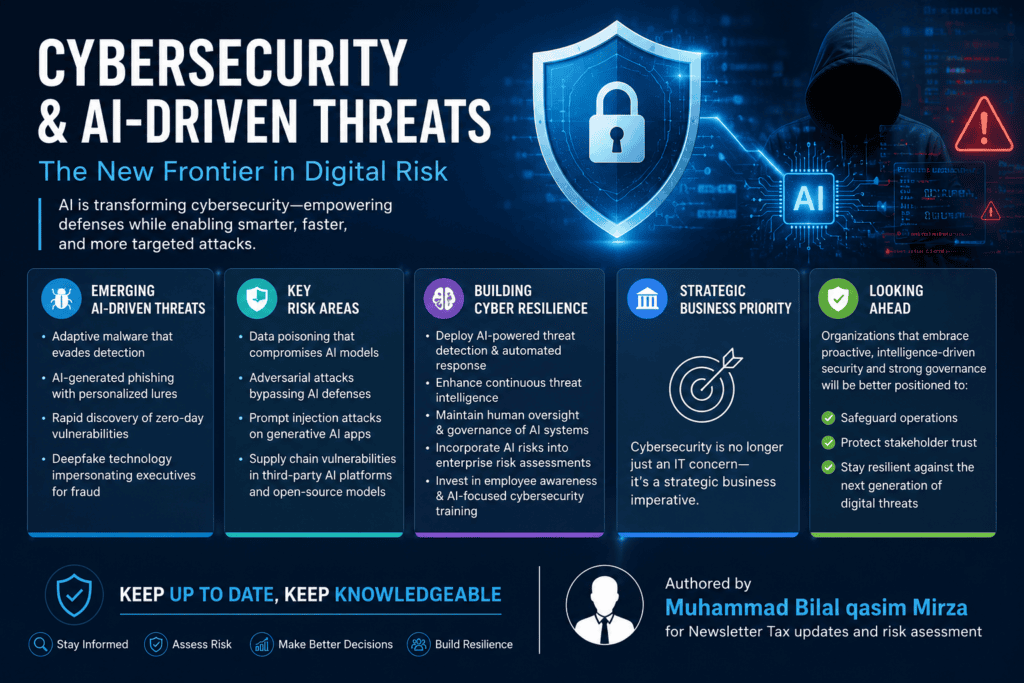

Cybersecurity & AI-Driven Threats: The New Frontier in Digital Risk
Researched by Hafsa Research and Analysis Company
Introduction
The convergence of cybersecurity and artificial intelligence (AI) has transformed both the defensive and offensive landscapes of digital security. While AI delivers powerful tools for threat detection and response, it also empowers cybercriminals to design highly sophisticated, scalable, and adaptive attacks that traditional defenses struggle to contain. As AI-driven cyber threats become one of the top concerns for security professionals in 2026, organizations must rethink risk assessments and defense strategies to protect critical infrastructure, data, and reputation.
1. The AI Double-Edged Sword in Cybersecurity
Artificial intelligence’s impact on cybersecurity is twofold:
- Defensive Advantage: AI enhances threat detection, anomaly identification, and automated response—an essential evolution beyond signature-based approaches.
- Offensive Acceleration: The same capabilities are being weaponized by attackers to craft more potent, adaptive, and personalized cyberattacks.
This dual nature has ushered in a new era of cyber risk where AI is both the defender and the threat, dramatically raising the stakes for risk management.
2. Core AI-Driven Cyber Threat Types
a. Automated & Adaptive Malware
AI tools empower attackers to automatically generate and modify malicious code, enabling polymorphic malware that changes structure to evade detection and defenses.
b. AI-Enhanced Phishing & Social Engineering
Cybercriminals use AI to craft highly credible phishing messages tailored to individuals, drastically improving the success rate of these attacks and bypassing traditional spam filters.
c. Zero-Day Exploit Discovery
AI accelerates the discovery of previously unknown vulnerabilities (zero-day exploits) by scanning massive codebases at speeds that far exceed human capabilities.
d. Deepfakes and Identity Impersonation
AI-generated synthetic media—including deepfake audio and video—can convincingly impersonate executives for fraud, extortion, or unauthorized access campaigns.
3. Real-World Risk Landscape
According to recent research, over half of cybersecurity professionals believe AI-driven threats and deepfakes will be among the top risks in 2026, yet only a fraction of organizations feel well-prepared to face these challenges.
Meanwhile, cyber threat volumes and automated attacks continue to surge:
- Automated vulnerability scans are reaching tens of thousands per second globally, reflecting a dramatic escalation in attack scale.
- Leading AI developers themselves warn that future AI models could significantly expand the number of potential attackers by making vulnerability discovery easier.
These developments make strategic AI risk assessment indispensable for any organization that depends on digital systems.
4. Key Vulnerabilities and Attack Vectors
a. Data Poisoning & Model Manipulation
Attackers can intentionally corrupt data used to train AI systems, leading to faulty decision-making or bypassed defenses.
b. Adversarial AI and Evasion Tactics
Cybercriminals can design inputs that deceive AI systems into misclassifying threats or failing to detect attacks—a significant risk for AI-based defenses.
c. Prompt Injection & Model Abuse
Weak safeguards around AI prompts can allow attackers to manipulate AI behavior, potentially exposing sensitive data or creating unauthorized actions.
d. Supply Chain & Third-Party Risk
AI vulnerabilities within third-party services or open-source models can introduce exploitable weaknesses for attackers targeting the ecosystem.
5. Strategic Defensive Approaches
a. AI-Augmented Cybersecurity Tools
Organizations increasingly deploy AI-powered defense mechanisms that analyze patterns, detect anomalies, and respond in real time—especially when traditional rule-based tools fall short.
b. Continuous Threat Intelligence
AI accelerates threat intelligence by correlating diverse data streams and identifying emerging attack vectors faster than manual processes.
c. Human-Centered Security Governance
Despite automation, human expertise remains essential for contextual judgment, ethical oversight, and strategic decision-making that AI alone cannot provide.
d. Hybrid Risk Assessment Models
Modern risk assessments now integrate AI metrics, such as model confidence, explainability, and resilience against adversarial inputs, alongside traditional cybersecurity KPIs.
6. Organizational Implications and Risk Strategy
Cyber risk governance in the AI era must cover:
- Policy & Compliance Alignment: Ensure policies keep pace with evolving AI threats and data protection standards.
- Training & Awareness: Educate teams on both the opportunities and risks posed by AI technologies.
- Incident Response Automation: Invest in AI-driven response playbooks that can react at machine speed.
- Cross-Functional Collaboration: Align cybersecurity, risk, and business strategy to manage AI risks holistically.
Failing to incorporate these elements can result in operational disruption, financial loss, regulatory penalties, and reputational damage.
Expert Insights: Perspectives from Cybersecurity Leaders
Leading cybersecurity research (e.g., from ISACA) indicates that AI-driven cyber threats are the primary concern for professionals heading into 2026, with deepfakes, automated phishing, and advanced malware topping the risk agenda. However, many organizations still lack adequate preparedness to mitigate these threats effectively.
Security industry leaders also emphasize that defending against AI-enabled attacks often requires AI-enhanced defenses themselves—a strategic shift from legacy cybersecurity tools toward predictive and adaptive security technologies.
Final Thoughts
The cybersecurity landscape in the AI era is characterized by rapid evolution, higher attack sophistication, and an accelerating arms race between defenders and attackers. AI-driven threats are now among the most significant risks organizations face, capable of bypassing traditional safeguards and exploiting scale, speed, and automation. To navigate this environment, businesses must adopt proactive, intelligence-driven cybersecurity strategies that leverage AI for defense while continuously evaluating and mitigating the risks posed by emerging threats. Integrating AI into cybersecurity risk assessments is no longer optional—it is essential to preserving resilience, data integrity, and stakeholder trust in a future where digital risk knows no bounds
Researched by Hafsa Research and Analysis Company