

Researched by Hafsa Research and Analysis Company
Past vs Future Perspectives of IFRS 19
Introduction
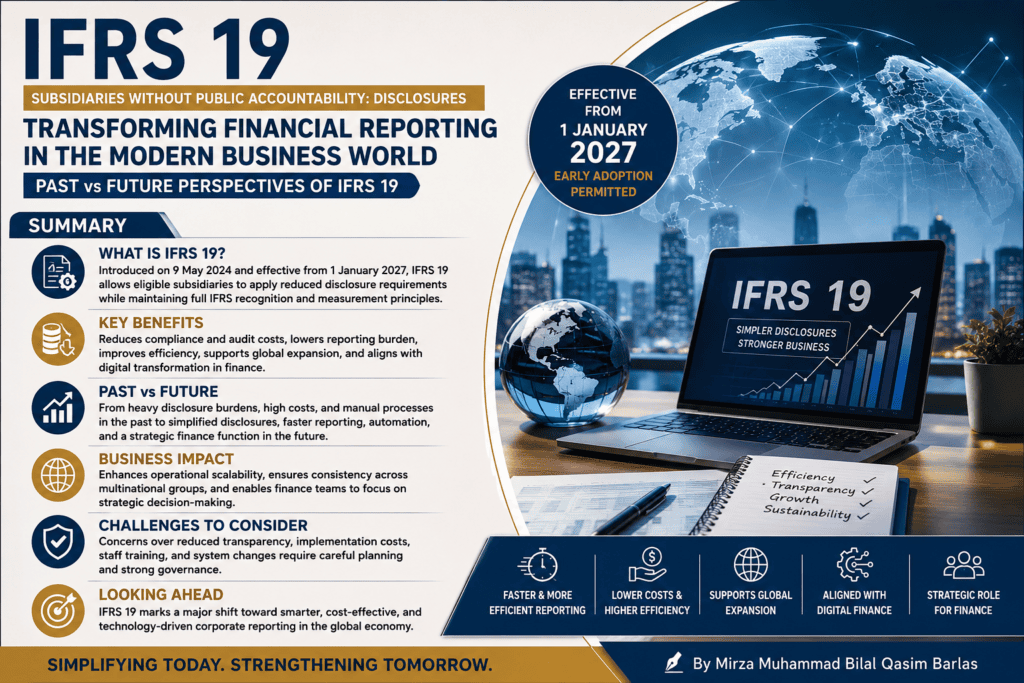
International Accounting Standards Board introduced IFRS 19 — Subsidiaries without Public Accountability: Disclosures on 9 May 2024 as a landmark development in international financial reporting. The standard is designed to reduce disclosure requirements for eligible subsidiaries while maintaining the recognition, measurement, and presentation principles of full IFRS Accounting Standards.
IFRS 19 represents a strategic shift in global accounting practices. It addresses one of the most persistent challenges faced by subsidiaries worldwide: the excessive burden of complex disclosures despite having no public accountability. By simplifying reporting obligations without compromising financial reporting quality, IFRS 19 aims to improve efficiency, reduce compliance costs, and modernize corporate financial reporting systems.
The standard becomes effective from 1 January 2027, although early adoption is permitted. Its introduction reflects the evolving needs of modern businesses operating in an increasingly digital, globalized, and cost-conscious economic environment.
Understanding IFRS 19
IFRS 19 allows eligible subsidiaries to apply reduced disclosure requirements while continuing to follow full IFRS recognition and measurement principles. This means companies can maintain high-quality financial reporting without preparing extensive disclosures that may provide limited practical value to users of financial statements.
The main objectives of IFRS 19 include:
- Reducing unnecessary reporting complexity
- Lowering compliance and audit costs
- Enhancing operational efficiency
- Improving consistency within multinational groups
- Supporting global business scalability
- Encouraging wider adoption of IFRS Accounting Standards
Eligible subsidiaries must:
- Not have public accountability
- Have a parent entity producing publicly available consolidated IFRS financial statements
- Elect voluntarily to apply IFRS 19
The standard is particularly beneficial for subsidiaries operating within multinational groups, family-owned business structures, and mid-sized corporate entities.
Significance of IFRS 19
1. Reduction in Reporting Burden
Before IFRS 19, subsidiaries applying full IFRS Accounting Standards were required to prepare extensive disclosures regardless of their operational size or complexity. This created unnecessary pressure on finance departments and increased the cost of compliance.
IFRS 19 significantly reduces:
- Disclosure preparation time
- Reporting complexity
- Administrative workload
- Financial statement preparation costs
This allows finance professionals to focus more on strategic financial management rather than excessive compliance procedures.
2. Consistency within Corporate Groups
One of the major advantages of IFRS 19 is that it helps multinational corporations maintain consistency across group reporting systems.
Previously, many subsidiaries maintained:
- One reporting system for local GAAP
- Another for IFRS consolidation purposes
IFRS 19 simplifies this structure by reducing duplication and supporting more unified reporting frameworks across global corporate groups.
3. Simplified Financial Reporting
The standard introduces a more streamlined disclosure framework compared to full IFRS requirements. Financial statements become:
- Easier to prepare
- More cost-efficient
- Operationally practical
- Simpler for internal management purposes
Despite reduced disclosures, the financial statements continue to maintain reliability and comparability through full IFRS recognition and measurement principles.
4. Support for Modern Digital Finance Systems
Modern businesses increasingly rely on:
- ERP systems
- AI-driven accounting platforms
- Cloud-based reporting solutions
- Automated financial systems
IFRS 19 complements these developments because simplified disclosure requirements:
- Improve automation efficiency
- Reduce system complexity
- Enhance reporting speed
- Lower technological maintenance costs
This positions IFRS 19 as a modern accounting standard aligned with digital transformation trends.
Impact of IFRS 19 on the Modern Business World
1. Reduction in Compliance Costs
One of the most significant impacts of IFRS 19 is the reduction in compliance and audit costs.
Under traditional full IFRS reporting:
- Large accounting teams were often required
- Disclosure preparation consumed substantial resources
- Audit procedures became increasingly complex
IFRS 19 reduces these burdens, particularly benefiting:
- Mid-sized subsidiaries
- International business groups
- Family-owned corporate structures
- Expanding multinational entities
In a competitive global economy where businesses prioritize operational efficiency, reducing financial reporting costs provides a major strategic advantage.
2. Improved Reporting Efficiency
Modern corporations increasingly seek faster and more efficient reporting systems.
IFRS 19 enhances operational efficiency by:
- Reducing duplication between group and subsidiary reporting
- Accelerating financial statement preparation
- Improving reporting timelines
- Lowering administrative burdens
This efficiency becomes especially valuable for:
- Cross-border business groups
- Shared service accounting centers
- Digitally integrated finance departments
3. Enhanced Global Business Expansion
Global corporations frequently establish subsidiaries across multiple jurisdictions. Historically, extensive IFRS disclosure requirements increased the complexity and cost of international expansion.
IFRS 19 supports globalization by:
- Lowering reporting barriers
- Simplifying international compliance
- Supporting foreign direct investment structures
- Improving multinational scalability
As global business integration continues to expand, IFRS 19 provides businesses with a more flexible and efficient reporting environment.
4. Transformation of the Finance Function
Traditionally, finance departments focused heavily on:
- Compliance
- Technical disclosures
- Historical reporting
- Audit coordination
However, IFRS 19 supports the transition toward a more strategic finance function focused on:
- Financial analysis
- Forecasting
- Performance management
- Mergers and acquisitions
- Strategic decision-making
Modern CFOs are increasingly expected to act as strategic business leaders rather than purely compliance-oriented professionals.
Past vs Future Aspects of IFRS 19
Past Environment Before IFRS 19
Heavy Disclosure Burden
Before IFRS 19, subsidiaries applying full IFRS standards faced extensive disclosure requirements regardless of their size or operational complexity. This resulted in:
- Excessive reporting documentation
- Increased workload for finance teams
- High compliance costs
- Limited operational flexibility
Many subsidiaries produced disclosures that provided minimal practical value while consuming significant resources.
High Compliance and Audit Costs
Under traditional reporting frameworks:
- Companies required larger accounting teams
- Audit procedures became more extensive
- Reporting systems became increasingly expensive
Smaller subsidiaries particularly struggled with the technical complexity of full IFRS disclosures.
Limited Reporting Flexibility
Prior to IFRS 19, subsidiaries generally had only two choices:
- Apply full IFRS disclosures
- Shift entirely to local GAAP frameworks
This often created inconsistency across multinational organizations and complicated group reporting processes.
Future Environment Under IFRS 19
Simplified and Efficient Reporting
The future of IFRS 19 is centered on simplification and efficiency.
Eligible subsidiaries can now:
- Apply reduced disclosures
- Maintain IFRS consistency
- Produce streamlined financial statements
Future reporting systems are expected to become:
- Faster
- More automated
- More scalable
- More cost-efficient
Increased Digital Transformation
The future business environment is increasingly driven by:
- Artificial Intelligence (AI)
- Cloud accounting
- ERP integration
- Real-time financial reporting
- Data automation
IFRS 19 aligns closely with these technological developments by simplifying reporting structures and improving automation capabilities.
Strategic Evolution of Finance Professionals
The role of finance professionals is evolving rapidly.
Future finance teams will focus more on:
- Strategic planning
- Data-driven decision-making
- Business intelligence
- Corporate advisory
- Investment analysis
By reducing disclosure burdens, IFRS 19 allows finance professionals to contribute more directly to organizational growth and strategic development.
Comparative Overview
| Aspect | Past Reporting Environment | Future Under IFRS 19 |
| Disclosure Requirements | Extensive and complex | Simplified and reduced |
| Compliance Costs | High | Lower and more efficient |
| Reporting Speed | Slow and manual | Faster and automated |
| Technology Integration | Limited | Highly digitalized |
| Finance Function | Compliance-focused | Strategic-focused |
| Global Expansion | Reporting barriers existed | Easier scalability |
| Audit Complexity | Extensive audits | More efficient reviews |
| Operational Efficiency | Lower | Higher |
Challenges and Considerations
Despite its advantages, IFRS 19 also introduces several challenges.
Reduced Transparency Concerns
Some stakeholders may argue that fewer disclosures could:
- Reduce transparency
- Limit information available to creditors
- Affect detailed financial analysis
Maintaining the balance between simplification and transparency will remain important.
Transition and Implementation Challenges
Businesses adopting IFRS 19 may initially face:
- Staff training requirements
- System modification costs
- Policy restructuring
- Coordination challenges with auditors
Careful implementation planning will therefore be essential.
Conclusion
IFRS 19 represents a major evolution in global financial reporting. It reflects the growing need for simplified, efficient, and technology-oriented accounting frameworks in the modern business world.
In the past, subsidiaries faced excessive disclosure requirements, high compliance costs, and operational inefficiencies. IFRS 19 introduces a future-focused approach that supports:
- Simplification
- Digital transformation
- Cost optimization
- Strategic finance
- Global scalability
The standard is more than just an accounting reform; it is part of a broader transformation toward smarter and more sustainable corporate reporting systems. As businesses continue to evolve in an increasingly competitive and digital global economy, IFRS 19 may become one of the most influential developments in modern financial reporting practices
Researched by Hafsa Research and Analysis Company