

Researched by Hafsa Research and Analysis Company
From Business Exit to Value Creation
Keep Up to Date. Keep Knowledgeable.
Deal Advisory (Sell-Side): The Strategic Science of Maximizing Enterprise Value
Introduction
Selling a business is one of the most significant financial decisions an entrepreneur, shareholder, or private equity investor will ever make. Yet contrary to common perception, successful business sales are not driven by luck or simply finding a buyer—they are carefully engineered through structured planning, financial analysis, strategic positioning, and competitive transaction management.
Sell-side deal advisory represents the discipline of preparing, positioning, marketing, negotiating, and executing the sale of a business while maximizing shareholder value and minimizing transaction risks. It combines corporate finance, valuation, financial reporting, commercial strategy, taxation, legal coordination, operational analysis, negotiation psychology, and capital market intelligence into a single advisory engagement.
Modern sell-side advisors no longer function merely as intermediaries between buyers and sellers. They serve as strategic architects who transform businesses into investment-grade opportunities capable of attracting premium valuations from strategic buyers, private equity firms, sovereign wealth funds, family offices, institutional investors, and multinational corporations.
As global mergers and acquisitions (M&A) activity continues to exceed trillions of dollars annually, sell-side advisory has become one of the highest-value services within investment banking, Big Four advisory firms, corporate finance boutiques, and management consulting organizations.
How Sell-Side Deal Advisory Works
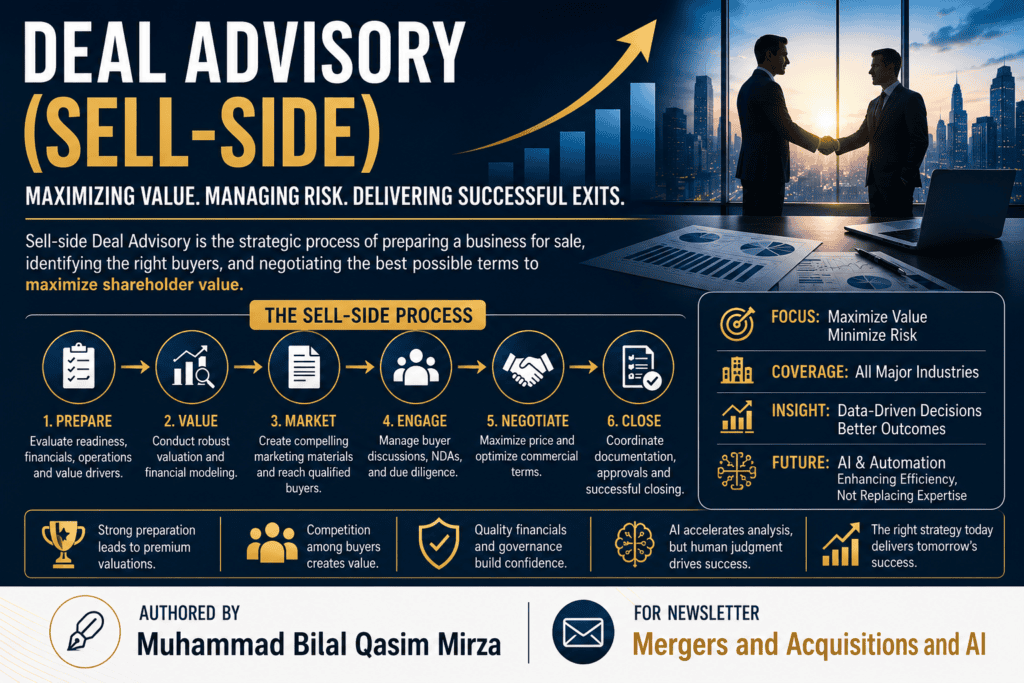
A sell-side transaction follows a structured lifecycle designed to maximize value while ensuring transaction certainty.
1. Strategic Readiness Assessment
The advisory engagement begins with evaluating whether the company is ready for sale.
Key considerations include:
- Financial reporting quality
- Historical profitability
- Working capital stability
- Management strength
- Operational scalability
- Customer concentration
- Legal compliance
- Regulatory exposure
- Tax position
- Intellectual property
- ESG readiness
- Market timing
At this stage advisors identify value gaps before approaching buyers.
2. Financial Preparation
Financial information is transformed into an investor-ready format.
This includes:
- Financial statement normalization
- EBITDA adjustments
- Working capital analysis
- Cash flow assessment
- Debt restructuring
- Forecast preparation
- Business plan development
- KPI analysis
- Quality of Earnings (QoE)
- Historical trend analysis
The objective is presenting sustainable earnings rather than accounting profits.
3. Business Valuation
Multiple valuation techniques are applied including:
- Discounted Cash Flow (DCF)
- Comparable Company Analysis
- Comparable Transaction Analysis
- Asset-Based Valuation
- Earnings Multiples
- Revenue Multiples
- Leveraged Buyout (LBO) valuation
The outcome is establishing an expected valuation range before negotiations begin.
4. Marketing the Business
The business is professionally positioned to the market through:
- Information Memorandum (IM)
- Teaser Documents
- Financial Fact Books
- Data Rooms
- Investor Presentations
- Management Presentations
Potential buyers are carefully screened based on strategic fit and financial capability.
5. Buyer Engagement
Interested buyers proceed through multiple stages:
- Non-Disclosure Agreements (NDAs)
- Initial discussions
- Indicative offers
- Management meetings
- Due diligence
- Binding offers
Competition among buyers generally increases transaction value.
6. Negotiation
Advisors negotiate:
- Purchase price
- Enterprise Value
- Equity Value
- Working Capital Adjustment
- Earn-out structures
- Deferred consideration
- Representations and warranties
- Indemnities
- Completion accounts
- Closing conditions
Negotiation often determines millions of dollars in additional shareholder value.
7. Transaction Completion
The final stage includes:
- Legal documentation
- Regulatory approvals
- Tax clearance
- Funds transfer
- Closing mechanics
- Post-deal transition
The advisor ensures successful execution from signing through completion.
Nature of the Work
Sell-side advisory combines analytical rigor with commercial strategy.
Professionals spend their time across multiple disciplines.
Financial Analysis
- Historical financial review
- Forecast modeling
- EBITDA normalization
- Working capital optimization
- Cash flow forecasting
Valuation
- Enterprise valuation
- Scenario analysis
- Sensitivity analysis
- Synergy assessment
Transaction Management
- Buyer communication
- Due diligence coordination
- Data room management
- Timeline management
Strategic Advisory
- Exit strategy
- Buyer targeting
- Market positioning
- Competitive auction management
Stakeholder Management
Professionals regularly engage with:
- CEOs
- CFOs
- Shareholders
- Investment funds
- Lawyers
- Tax advisors
- Commercial bankers
- Auditors
- Regulators
Every engagement requires balancing financial precision with relationship management.
Sectors Involved
Sell-side advisory spans virtually every major industry.
Technology
- SaaS
- Artificial Intelligence
- FinTech
- Cybersecurity
- Cloud Computing
- Enterprise Software
Healthcare
- Hospitals
- Pharmaceuticals
- Medical Devices
- Biotechnology
- Diagnostics
- Healthcare Technology
Financial Services
- Commercial Banking
- Insurance
- Asset Management
- Wealth Management
- FinTech Platforms
Consumer & Retail
- E-Commerce
- FMCG
- Luxury Brands
- Food & Beverage
- Hospitality
Manufacturing
- Industrial Products
- Automotive
- Aerospace
- Chemicals
- Engineering
Energy
- Renewable Energy
- Oil & Gas
- Utilities
- Infrastructure
Real Estate
- Commercial Property
- Residential Development
- REITs
- Construction
Logistics & Transportation
- Freight Forwarding
- Shipping
- Ports
- Warehousing
- Aviation
Telecommunications
- Mobile Operators
- Fiber Networks
- Data Centers
Government & Infrastructure
- PPP Projects
- Smart Cities
- Transportation Infrastructure
Numbers & Insights
The global M&A market remains one of the largest capital allocation mechanisms in the world.
Key observations include:
- Annual global M&A activity is routinely measured in trillions of US dollars, with thousands of transactions completed across strategic, financial, and cross-border buyers.
- Mid-market transactions (roughly US$10 million–US$500 million enterprise value) account for a significant share of deal volume, while mega-deals contribute disproportionately to total transaction value.
- Strategic acquirers often pay higher valuation multiples when identifiable revenue, cost, or technology synergies are present.
- Businesses with recurring revenue, strong cash generation, diversified customers, and scalable operating models generally command premium EBITDA multiples.
- Competitive auction processes frequently produce stronger outcomes than one-to-one negotiations by creating pricing tension among qualified buyers.
- Robust due diligence preparation can materially reduce execution risk, shorten deal timelines, and lessen the likelihood of value erosion during negotiations.
- Environmental, Social, and Governance (ESG) performance, cybersecurity resilience, and AI readiness are increasingly evaluated alongside traditional financial metrics during buyer assessments.
Expert Insights
Exceptional sell-side advisors focus on value creation long before a transaction begins.
1. Buyers Purchase Future Cash Flows
Historical performance establishes credibility, but valuation is primarily driven by expectations regarding future earnings, growth, scalability, and risk.
2. Preparation Creates Premium Valuation
Businesses that proactively resolve operational, financial, tax, and legal issues before entering the market generally experience stronger pricing and smoother execution.
3. Quality of Earnings Drives Confidence
Transparent, sustainable earnings are significantly more persuasive than aggressive accounting adjustments. Credibility often influences valuation as much as growth.
4. Competition Creates Value
Structured buyer outreach and well-managed auction processes can enhance negotiating leverage and increase shareholder returns.
5. Management Quality Matters
Experienced leadership teams with clear strategic vision and execution capability often increase buyer confidence and support higher valuation multiples.
6. Data Tells the Story
Advanced analytics, KPI dashboards, customer retention metrics, operational performance indicators, and predictive forecasting strengthen the investment narrative.
The Effect of Automation and Artificial Intelligence
Artificial Intelligence is rapidly reshaping sell-side deal advisory by improving efficiency, insight generation, and decision support.
AI Applications
Financial Analysis
AI accelerates:
- Financial statement review
- Trend identification
- Anomaly detection
- Ratio analysis
- Forecast generation
Valuation
Machine learning models support:
- Comparable company identification
- Market multiple analysis
- Valuation benchmarking
- Sensitivity simulations
Due Diligence
AI-powered platforms can rapidly review large volumes of:
- Contracts
- Financial records
- Compliance documentation
- Legal agreements
- Operational data
This reduces manual effort and enables advisors to focus on higher-value analysis.
Buyer Identification
AI helps profile potential acquirers based on:
- Acquisition history
- Strategic priorities
- Geographic presence
- Industry focus
- Financial capacity
Virtual Data Rooms
Modern data rooms increasingly incorporate AI-driven capabilities such as intelligent document categorization, access monitoring, automated summaries, and advanced search functionality, improving collaboration and transaction transparency.
Predictive Analytics
Advanced analytical models help estimate:
- Transaction success probability
- Expected valuation ranges
- Buyer behavior
- Negotiation scenarios
- Market timing
Human Judgment Remains Critical
Despite these advancements, AI cannot replace the strategic judgment required to negotiate complex transactions, manage sensitive stakeholder relationships, understand corporate culture, or navigate nuanced commercial dynamics. The future of sell-side advisory is likely to be defined by advisors who effectively combine advanced technology with deep financial expertise.
- How to Become an Expert in Sell-Side Deal Advisory
Building expertise requires technical excellence, commercial awareness, and practical transaction experience.
1. Develop Strong Financial Foundations
Master:
- IFRS and financial reporting
- Corporate finance
- Financial statement analysis
- Valuation techniques
- Capital structure
- Working capital management
2. Learn Financial Modeling
Become proficient in:
- Three-statement models
- DCF valuation
- LBO modeling
- Merger models
- Sensitivity analysis
- Scenario planning
3. Understand Transactions
Study:
- M&A processes
- Due diligence
- Purchase agreements
- Deal structuring
- SPA mechanisms
- Regulatory considerations
4. Strengthen Commercial Skills
Develop expertise in:
- Industry research
- Market analysis
- Competitive strategy
- Negotiation
- Executive communication
- Stakeholder management
5. Build Digital Capabilities
Modern advisors should understand:
- Artificial Intelligence applications
- Data analytics
- Power BI
- Excel automation
- SQL fundamentals
- Business intelligence platforms
- Financial data visualization
6. Pursue Professional Qualifications
Highly regarded credentials include:
- ACCA
- ACA / ICAEW
- CFA
- CPA
- MBA (Corporate Finance or Strategy)
- FMVA (Financial Modeling & Valuation Analyst)
7. Gain Transaction Experience
Hands-on involvement in live engagements—whether in investment banking, corporate finance, private equity, transaction services, or strategic advisory—is invaluable. Exposure to deal execution develops judgment that cannot be fully replicated through classroom learning.
Conclusion
Sell-side deal advisory is far more than facilitating the sale of a company. It is a disciplined process of preparing businesses for the market, articulating a compelling investment story, identifying the right buyers, and negotiating outcomes that maximize long-term shareholder value.
As capital markets become increasingly data-driven and technology-enabled, the role of the advisor is evolving. Artificial intelligence, automation, advanced analytics, and digital collaboration tools are accelerating transaction execution and enhancing decision-making. Yet the defining elements of successful sell-side engagements—strategic insight, rigorous financial analysis, disciplined preparation, and trusted relationships—remain fundamentally human.
Organizations that invest early in operational excellence, financial transparency, governance, and strategic positioning are better equipped to command premium valuations and execute transactions with confidence. For finance professionals, mastering sell-side advisory offers a unique opportunity to influence transformational corporate decisions, bridge strategy with execution, and create enduring value in an increasingly competitive global marketplace.
Researched by Hafsa Research and Analysis Company