
prepared by Hafsa Research and Analysis Company
Executive Insight
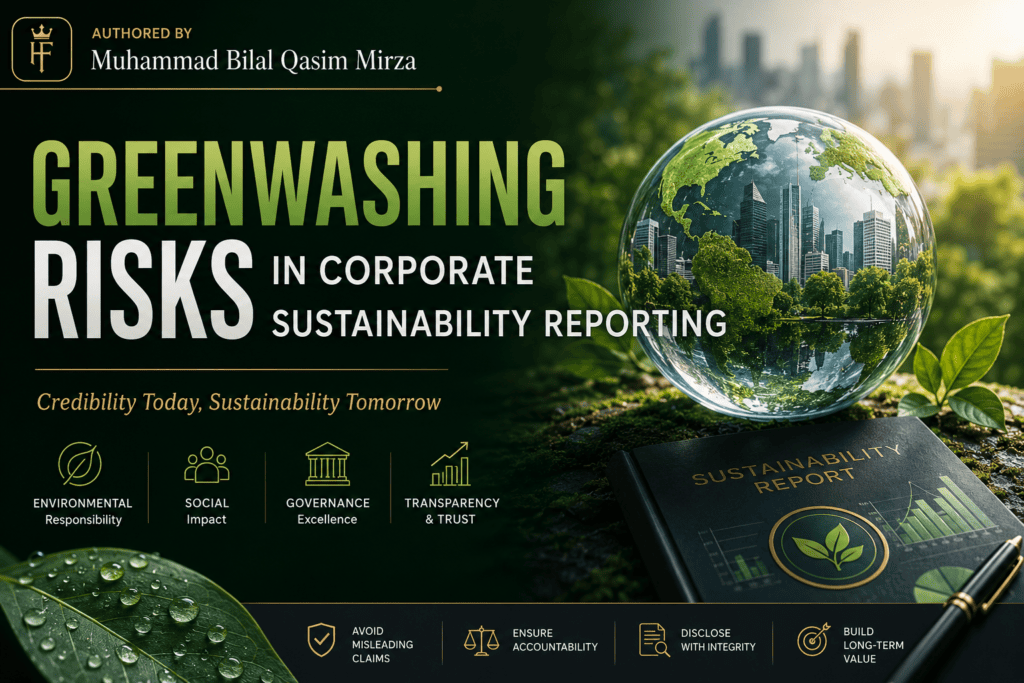
Sustainability has moved from a communications issue to a financial, regulatory and governance issue.
Investors increasingly want evidence behind ESG claims. Lenders may assess sustainability performance when structuring financing. Regulators are paying greater attention to misleading environmental claims. Customers increasingly expect companies to demonstrate that sustainability commitments translate into genuine operational action.
This creates a critical management challenge:
Can your organisation prove every material sustainability claim it makes?
If the answer is uncertain, the business may have a greenwashing risk.
The solution is not simply producing a longer ESG report.
It is building a system in which every material sustainability statement can be traced to reliable data, defined methodology, management ownership and supporting evidence.
1. Start With a Greenwashing Risk Assessment
Management should first identify where misleading or unsupported claims could arise.
Review:
- Sustainability reports
- Annual reports
- Investor presentations
- Websites
- Product packaging
- Marketing campaigns
- Net-zero commitments
- Climate targets
- Green-finance disclosures
- Supplier sustainability claims
Then classify each statement:
Verified → Supported by evidence
Partially supported → Evidence incomplete
Aspirational → Future objective
Unsupported → Immediate remediation required
This creates a Sustainability Claims Register.
Recommended fields
Claim | Owner | Data Source | Measurement Method | Evidence | Target Date | Assurance Status | Risk Rating
If a claim cannot be supported, management should reconsider how it is presented.
2. Apply the “Evidence Before Claim” Principle
A powerful internal rule is:
No material ESG claim without evidence.
For example, instead of saying:
“We are an environmentally friendly company.”
Management should be able to demonstrate:
What environmental impact is being measured?
What is the baseline?
What period is being measured?
What methodology is used?
What improvement has occurred?
Who reviewed the information?
This changes sustainability communication from marketing language to evidence-based reporting.
3. Build an ESG Data Control Framework
Greenwashing can originate from poor data rather than deliberate deception.
ESG information may come from finance, operations, HR, procurement, facilities, suppliers and external databases.
The CFO should therefore establish controls similar to financial reporting controls.
ESG data should have:
Defined ownership
Documented methodology
Source documentation
Review procedures
Change controls
Reconciliation processes
Approval hierarchy
Audit trail
The objective is to create an ESG reporting control environment.
4. Connect ESG With Financial Reporting
Sustainability should not operate as a separate reporting universe.
Management should ask:
How does a sustainability risk affect the financial statements and enterprise value?
For example:
Climate risk → Asset impairment risk
Carbon pricing → Operating cost
Extreme weather → Supply-chain disruption
Energy transition → Capital expenditure
Environmental regulation → Compliance cost
Reputational damage → Revenue/customer risk
Poor ESG performance → Financing implications
This is where ESG becomes relevant to the CFO, valuation team and board, rather than remaining primarily a communications function.
5. Use IFRS S1 and IFRS S2 as a Governance Framework
IFRS S1 and IFRS S2 provide an important foundation for sustainability-related financial disclosures.
Management should establish a readiness assessment covering:
Governance
Who is responsible for sustainability-related risks and opportunities?
Strategy
How could those risks and opportunities affect the business model and strategy?
Risk Management
How are sustainability and climate risks identified, assessed and monitored?
Metrics & Targets
Which measures demonstrate actual performance?
The practical objective is not merely to “publish an IFRS S1/S2 report.”
It is to create the systems and controls capable of producing reliable disclosures.
6. Stress-Test Net-Zero Commitments
Net-zero announcements can create significant credibility risk when targets are not supported by a realistic implementation pathway.
Management should test:
Baseline emissions
→ Reduction target
→ Annual milestones
→ Required investment
→ Operational changes
→ Technology assumptions
→ Offset dependence
→ Residual emissions
→ Expected achievement date
If the organisation cannot explain how the target will be achieved, it should not present the commitment as though it were already an operational reality.
Board question:
“Show us the investment plan behind the sustainability target.”
7. Establish a Greenwashing Early-Warning Dashboard
The board should monitor indicators such as:
| Indicator | Warning Signal |
| ESG claims | Claims exceed available evidence |
| Emissions | Reported improvement lacks supporting data |
| Targets | No funded implementation plan |
| Suppliers | Supplier claims not independently validated |
| Disclosures | Annual and sustainability reports conflict |
| Assurance | Material metrics remain unverified |
| Governance | No clear executive ownership |
| Litigation | Complaints or regulatory inquiries increasing |
This converts greenwashing from a communications issue into a board-level risk indicator.
8. The 90-Day Greenwashing Prevention Programme
Days 1–30 — Identify
Create an inventory of ESG claims, targets, metrics and public statements.
Assess each claim for evidence, ownership and regulatory risk.
Days 31–60 — Control
Build the ESG data-control framework.
Standardise methodologies, establish documentation requirements and assign accountability.
Days 61–90 — Validate
Conduct internal testing and, where appropriate, independent assurance.
Reconcile sustainability information with financial and corporate reporting.
Remove, correct or qualify unsupported claims.
The objective is:
Claim → Evidence → Control → Review → Disclosure
9. The CEO/CFO Greenwashing Checklist
Before publishing a material sustainability statement, ask:
1. Is the claim factually accurate?
2. Can we demonstrate the underlying evidence?
3. Is the measurement methodology clearly defined?
4. Have material negative facts been appropriately considered?
5. Is the claim consistent with our annual and financial reporting?
6. Does the target have a credible implementation plan?
7. Has management identified the financial implications?
8. Is there appropriate governance and accountability?
9. Does the claim comply with applicable reporting and marketing requirements?
10. Could an investor, regulator or customer reasonably interpret the statement differently from what the evidence supports?
If the answer to the final question is “yes”, the wording deserves further review.
The Strategic Value to Management
A credible ESG framework can deliver value beyond compliance.
It can help management:
Protect corporate reputation
Improve investor confidence
Strengthen sustainability-finance readiness
Identify climate-related financial risks
Improve data quality
Strengthen board oversight
Reduce regulatory exposure
Improve strategic decision-making
Most importantly, it allows the organisation to demonstrate that sustainability is embedded in the business rather than simply communicated by the business.
Final Takeaway
Greenwashing is ultimately a credibility gap between what an organisation says and what it can prove.
The solution is therefore not better marketing.
It is better data, governance, controls, evidence and accountability.
The future of ESG reporting will increasingly favour organisations that can connect:
Sustainability Claim → Reliable Data → Financial Impact → Governance → Evidence
For CEOs and CFOs, the most important question is no longer:
“Does our company look sustainable?”
It is:
“Can we prove that our sustainability claims are accurate, measurable and financially meaningful?”
That is where ESG reporting evolves from corporate communication into corporate intelligence.
Prepared by Hafsa Research and Analysis Company