
Researched by Hafsa research and Analysis Company
Tagline: From scorekeepers to architects — why finance chiefs are now running the map.
Introduction — a role in flux
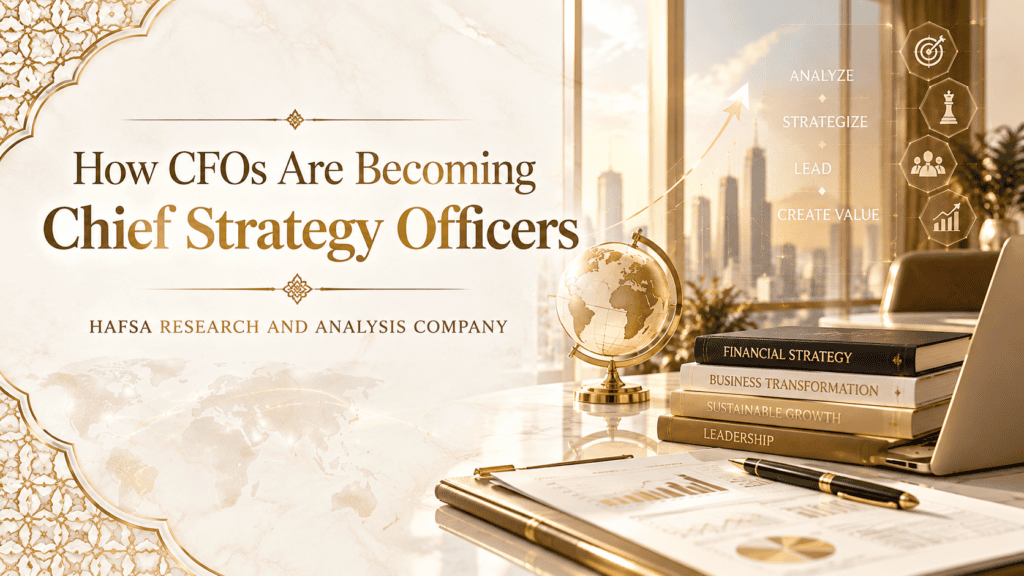
Once confined to month-end closes, regulatory filings and investor calls, the modern Chief Financial Officer is increasingly asked to run strategy — not just measure it. What was traditionally a numbers-first role has expanded into shaping what the company builds, buys and prioritizes. This isn’t incremental change; it’s a structural reframe: CFOs are becoming, in effect, Chief Strategy Officers for many organizations. Deloitte+1
Why this change is happening now
Several long-running forces have converged to make the CFO a natural strategic lead:
- Capital allocation is strategic: Big, transformative bets (AI, cloud, M&A) require financial architects who can size investments and build funding plans. CFOs control the language and levers of capital. Reuters
- Data & analytics: Finance teams now own richer, faster datasets and forecasts — enabling scenario planning and real-time strategy testing. Deloitte
- Investor and board expectations: Boards want measurable strategy, not glossy slideware. CFOs translate strategy into KPIs and risk frameworks. PwC
Real examples — who’s already doing it
Alphabet / Ruth Porat. Porat’s move from CFO into a broader investment role (president and chief investment officer) illustrates the trend: a finance chief who now directly guides where a company invests (AI, cloud infrastructure, other bets) and who publicly frames strategy at major conferences. Her public interviews emphasize directing capital toward long-term AI opportunities while balancing returns. Reuters+1
Microsoft / Amy Hood. Microsoft’s CFO has operated as a partner in strategic pivots (cloud, subscription models, major M&A). Microsoft’s investor discussions and internal transcripts show Amy Hood engaging deeply in product and investment strategy — working alongside the CEO and tech leads on execution of multi-billion dollar choices. Microsoft+1
Broader consulting research. Major consultancies and CFO programs now explicitly define the CFO as a “strategist” or “transformer” — advising boards that the CFO should own elements of strategy execution and capital-allocation frameworks. Deloitte+1
Comparing the past vs. organizations that made the shift
The past: CFOs focused on control, compliance, backward-looking reporting; strategy sat with the CEO/strategy office and often lacked the financial rigor to be operationalized. Handoffs between “strategy” and “finance” created slow execution and misaligned incentives. Harvard Business Review
Organizations that integrated CFO into strategy: They close the loop — strategy is designed with a finance lens and executed against measurable financial levers. Examples like Alphabet and Microsoft show faster capital re-allocation, tighter M&A decisioning and clearer trade-offs between growth investments and margins. The result: quicker, capital-efficient moves into priority markets. Reuters+1
Voices from the field (executive interviews & statements)
- Ruth Porat has spoken publicly about meeting customers “where they want to be next” — a strategic statement rooted in directing investment into AI and infrastructure. Her transition into an investment-first role is concrete evidence of the CFO → strategist arc. Reuters
- Microsoft’s investor events and transcripts show Amy Hood in deep strategic conversation about AI and cloud, reinforcing that Microsoft’s financial leadership is central to product and go-to-market choices. Microsoft+1
(These are representative, on-the-record examples where finance leaders act as public strategists — a trend reinforced by consulting firm analyses.) Deloitte+1
Pros — why putting strategy in the CFO’s hands can work
- Stronger capital discipline: Every strategic option gets evaluated with the same rigor as capital deployment. This reduces waste and mispriced bets. Deloitte
- Faster end-to-end execution: Fewer handoffs between “strategy” and “finance” speeds decisions and implementation. Deloitte
- Better investor/board alignment: The CFO speaks the board’s language — making it easier to secure buy-in for long-term plans. PwC
- Scenario planning & risk management: Finance’s forecasting expertise improves resilience under uncertainty.
Cons & risks — what to watch out for
- Short-termism pressure: If CFOs over-index to quarterly metrics (or boards pressure for short wins), strategy can be narrowed to near-term financial engineering. Guardrails are essential. PwC
- Technical vs. visionary trade-off: Not all CFOs are trained as product or market strategists. Putting too much of the “what to build” remit into finance risks underweighting customer and product perspective. Harvard Business Review
- Concentration of power: Combining capital control with strategy can centralize decisions — good for speed, but risky for diversity of thought and internal checks. Boards should preserve healthy challenge.
- Capability gaps: Finance teams must upskill in data science, commercial analytics and market insight to avoid shallow or numerically driven strategy.
How companies should organize for success
- Shared accountability: CFO-led strategy works best when paired with a strong commercial and product leadership — each owning complementary parts of the plan.
- New capabilities in finance: Invest in scenario modelling, commercial analytics, and cross-functional deal teams. Deloitte and PwC frameworks recommend reorienting finance toward forward-looking insights. Deloitte+1
- Clear KPIs & time horizons: Use a balanced set of metrics (leading and lagging) and protect long-horizon investments with staged governance.
- Board composition & process: Boards should ensure independent challenge (e.g., CSO or strategy committee) while leveraging CFO discipline.
The future — what the next 5–10 years will likely bring
- More fluid C-suite roles: Expect hybrid titles and role swaps (CFO → investment chief, CFO + CSO partnerships). Tech and capital-intensive sectors will lead. Barron’s
- Finance as a talent pipeline for CEOs: With strategic remit, CFOs will be stronger CEO candidates because they combine operating, capital and stakeholder credibility.
- Greater use of AI & real-time finance: Strategy testing and capital allocation will accelerate using simulation and AI-driven forecasting — making the CFO’s strategic influence even more operational. Deloitte
Final message
The shift of CFOs into chief strategy roles is not a takeover of vision by accountants — it’s the meeting point of capital discipline and strategic ambition. Organizations that balance finance rigor with commercial imagination will win. The path isn’t risk-free: short-term pressures, capability gaps and governance blind spots must be managed. But when done thoughtfully, a CFO who thinks like a strategist — and a CEO who trusts financial judgment — creates a powerful engine for sustainable growth.
Researched by Hafsa Research and Analysis Company