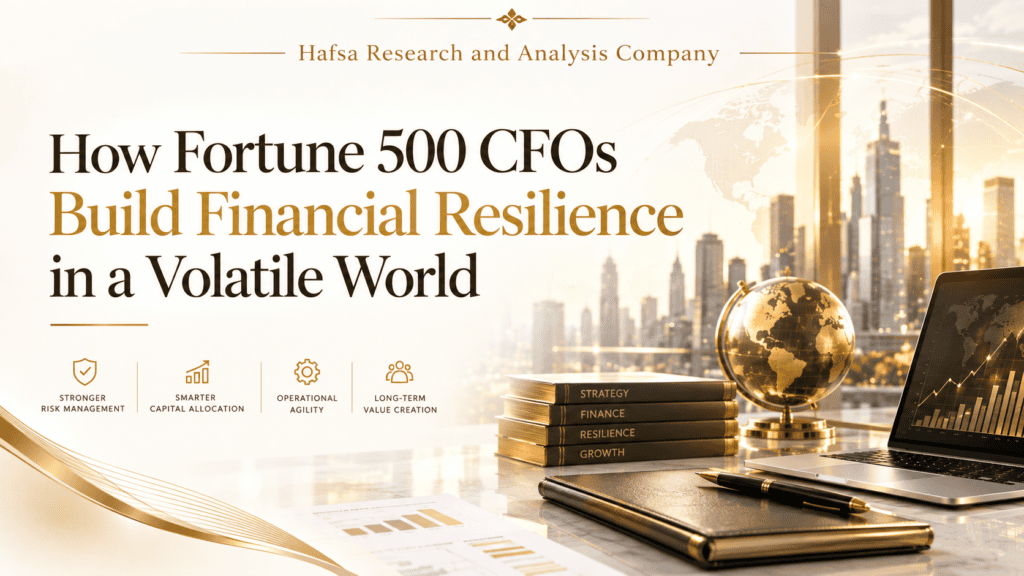

How Fortune 500 Finance Leaders Build Agility in an Age of Disruption
Prepared by Hafsa Research and Analysis Company
The Core Shift: From Efficiency to Absorption
The CFO role has fundamentally changed. In an era defined by cheap money and predictable demand, financial leadership was about optimizing a system designed to scale. That era is ending.
New research from PYMNTS Intelligence’s 2026 Certainty Project reveals that CFOs are being forced into a fundamentally different role—less concerned with optimization and more focused on absorption. Trade policy whiplash, geopolitical fragmentation, and rapid technological disruption have created an environment where “uncertainty itself has become a defining operating condition rather than a temporary phase”.
Deloitte’s 2026 CFO Survey confirms the shift: 70% of CFOs now identify geopolitical risk as a top-tier threat, and 88% report that organizational resilience is a priority.
The question is no longer whether disruption will come. It’s whether your finance function is built to absorb it.
Solution 1: Build Liquidity Buffers Before You Need Them
McKinsey’s latest CFO Pulse Survey found that nearly two-thirds of finance leaders are increasing cash and liquidity buffers to manage macro risks. This isn’t hoarding—it’s optionality.
UPS demonstrates the discipline required. The company scaled back Amazon delivery volume by approximately 2 million pieces per day over six quarters, achieving roughly $4.5 billion in cost savings. CFO Brian Dykes described the lesson: “However fast you think you’re going, you’re not going fast enough”.
The principle: Capital that can be redeployed quickly is worth more than capital perfectly optimized for a single scenario.
Action step: Run a 90-day liquidity forecast with a 30% revenue shock. Map your top 10 suppliers for single-point failures. Know your breakeven in stress.
Solution 2: Treat Scenario Planning as an Operating Rhythm
JPMorgan CFO Jeremy Barnum’s Q2 2026 commentary captures the discipline required at scale: “The market is clearly extremely risk-on, and we’re kind of takers of that. And we’re trying to strike the right balance between supporting all our clients and being appropriately cautious in an environment that has some complicated dynamics in it”.
This is the balance Fortune 500 CFOs must strike—participating in growth while maintaining downside protection.
Deloitte’s survey identifies the practical framework: multi-horizon scenarios linked to capital triggers. Ambu CFO Henrik Bender describes the approach: “The difference between expected and unexpected risks lies in preparation. I focus on identifying risks we can manage over time while balancing short-term responses”.
Action step: Dedicate one executive session per quarter to a realistic crisis simulation. Not a theoretical exercise—a full walkthrough of roles, decisions, and communication protocols.
Solution 3: Learn from Failures, Not Just Successes
GE’s cautionary tale: The industrial giant’s decline involved aggressive buybacks, opaque reporting, and over-extension in financial products. The lesson: buybacks and financial engineering destroy optionality when core operations slip.
Wells Fargo’s governance failure: The fake accounts scandal revealed how governance failures tied to incentives can lead to enormous fines and reputational harm. The lesson: incentive design is risk management.
Boeing’s organizational misalignment: The 737 MAX era exposed the cost of misaligned incentives between engineering and financial priorities. Fortune’s recent analysis describes Boeing’s turnaround under CEO Kelly Ortberg as “one of the most dramatic and rapid corporate recoveries on record”—driven by refocusing on engineering excellence over financial engineering.
Action step: Audit your top three incentive metrics. Ask: can this metric be gamed? What behavior does it actually reward? Adjust accordingly.
Solution 4: Invest in AI Foundations Before Scaling
Bank of America’s approach offers a practical model. CFO Alastair Borthwick reported 400,000+ AI prompts generated daily by employees, with 300+ approved AI use cases including 114 live generative AI applications. The payoff, he says, extends beyond cost cutting: “growth, efficiency, risk management and resiliency”.
But the sequence matters. EY’s guidance is clear: “AI ambition will only go so far without strong data and infrastructure”.
Action step: Before your next AI pilot, audit your data architecture. Can you trace every input? Can you explain every output? If not, fix that first.
Solution 5: Make Resilience a Board-Level Discipline
A 2026 CFO closed-door summit at Shanghai National Accounting Institute distilled six consensus points on financial resilience, including: “CFO role transitioning from back-office controller to value catalyst; technology paradigm shifting from efficiency tool to AI-native reconstruction”.
The practical implication: resilience is not a document. It is a discipline embedded in governance, capital allocation, and talent development.
Action step: Add one ethics-led KPI to monthly board packs (whistleblower trends, customer complaint resolution). Prepare a short investor note explaining three worst-case paths and management responses.
Executive Checklist: Immediate Actions
This week:
- Run a 90-day liquidity forecast with a 30% revenue shock
- Map top 10 suppliers for single-point failures
This month:
- Implement one ethics-led KPI into board reporting
- Draft an investor note on three worst-case scenarios
This quarter:
- Simulate a realistic crisis with your executive team
- Audit incentive metrics for gaming potential
Closing Thought
Resilience is not a contingency plan tucked in a drawer. It is a living discipline: real-time intelligence, disciplined capital choices, ethical controls, and a willingness to make hard trade-offs today to preserve optionality tomorrow.
As Deloitte’s Henrik Bender advises fellow CFOs: “Think beyond functional silos. Many of the best solutions emerge when you look across the organization. Resilience depends on having the right people in place with the authority to act—and the willingness to accept risk”.
The CFOs who build this capacity will not just survive disruption. They will define the terms on which their organizations engage with it.
Prepared by Hafsa Research and Analysis Company