

What Finance Leaders Need to Know Before the January 2027 Effective Date
Prepared by Hafsa Research and Analysis Company
The Core Shift: A Disclosure-Only Standard That Changes Everything
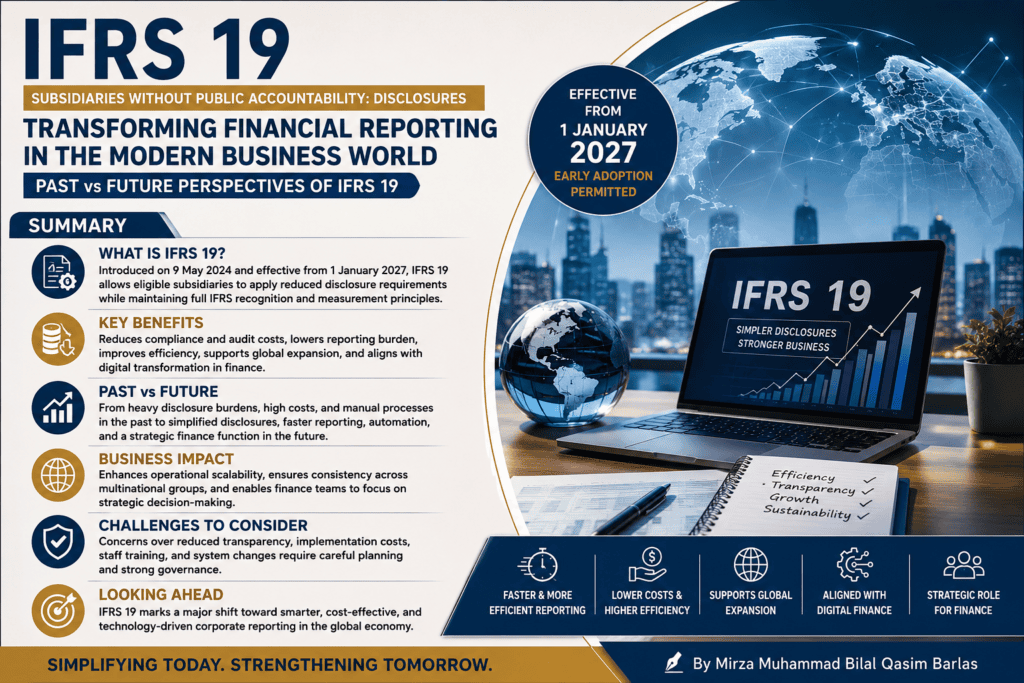
The IASB issued IFRS 19 Subsidiaries without Public Accountability: Disclosures in May 2024—a landmark development that fundamentally rethinks how eligible subsidiaries report . The standard is disclosure-only: it does not alter recognition, measurement, or presentation requirements. Eligible subsidiaries continue applying full IFRS for those elements, but replace the extensive disclosure requirements of other standards with IFRS 19’s reduced set .
The scale of impact is substantial. EFRAG’s research, using the Orbis database, identified approximately 152,026 subsidiaries in the EU/EEA potentially eligible to apply IFRS 19—or 91,681 when Member State options are considered . For multinational groups with complex subsidiary networks, this represents a structural opportunity to reduce compliance costs without compromising reporting quality.
The standard is effective for annual reporting periods beginning on or after 1 January 2027, with earlier application permitted .
Solution 1: Confirm Eligibility Before Planning
Eligibility requires meeting two conditions: the entity does not have public accountability, and its ultimate or intermediate parent produces consolidated financial statements available for public use that comply with IFRS Accounting Standards .
An entity has public accountability if its equity or debt instruments are traded in a public market, it is in the process of issuing such instruments, or it holds assets in a fiduciary capacity for a broad group of outsiders as one of its primary businesses .
IFRS 19 is voluntary. Eligible subsidiaries elect to apply it—they are not required to do so.
Action step: Audit your subsidiary population against these criteria. Identify entities that qualify and assess whether the cost-benefit case for election is compelling. For groups with multiple eligible subsidiaries, develop a consistent election policy.
Solution 2: Understand What Is Reduced—and What Remains
IFRS 19 reduces disclosures by applying the same principles used for the IFRS for SMEs Standard: focusing on information users of entities without public accountability actually need . Key reductions include:
- IAS 7 Statement of Cash Flows — supplier finance arrangement disclosures
- IAS 12 Income Taxes — Pillar Two model rules disclosures
- IAS 21 Foreign Exchange — lack of exchangeability disclosures
- IFRS 7 Financial Instruments — contingent feature disclosures
Critically, IFRS 19 does not reduce disclosures for IAS 33 Earnings per Share or IFRS 8 Operating Segments. Eligible subsidiaries are not required to apply these standards, but if they voluntarily disclose EPS or segment information, they must comply with the full requirements .
Action step: For each eligible subsidiary, map current disclosures against the reduced set. Identify which disclosures will be eliminated and which must remain. Flag any voluntary EPS or segment disclosures for careful review.
Solution 3: Prepare for the August 2025 Catch-Up Amendments
The IASB issued amendments to IFRS 19 in August 2025 to complete its “catch-up” work—reducing disclosure requirements for standards and amendments issued between February 2021 and May 2024 .
The amendments cover:
- IFRS 18 Presentation and Disclosure in Financial Statements
- Supplier Finance Arrangements (Amendments to IAS 7 and IFRS 7)
- International Tax Reform—Pillar Two Model Rules (Amendments to IAS 12)
- Lack of Exchangeability (Amendments to IAS 21)
- Classification and Measurement of Financial Instruments (Amendments to IFRS 9 and IFRS 7)
These amendments have the same effective date as IFRS 19—1 January 2027—with early application permitted for entities applying IFRS 19 early .
Action step: Review the amended disclosure requirements against your current reporting. For subsidiaries with Pillar Two exposure, assess whether the reduced disclosures provide sufficient information for users. For those with supplier finance arrangements, confirm the reduced disclosure meets stakeholder needs.
Solution 4: Address the Endorsement and Jurisdictional Landscape
IFRS 19 requires local endorsement before it can be applied in many jurisdictions. The UK Endorsement Board approved the amended standard for adoption on 8 May 2026 . EFRAG issued its final endorsement advice recommending EU adoption, concluding that IFRS 19 meets all technical criteria and is conducive to the European public good .
The European Commission’s endorsement request included additional analysis beyond technical criteria: cost-benefit assessment of potential savings, number of affected entities, and differences between IFRS 19 and the EU Accounting Directive .
Action step: Confirm the endorsement status in every jurisdiction where eligible subsidiaries operate. For EU entities, monitor the European Commission’s final adoption process. Do not assume IFRS 19 is available without local endorsement.
Solution 5: Prepare Transition and Stakeholder Communication
IFRS 19 does not include transition provisions comparable to those for recognition and measurement changes. Entities applying IFRS 19 must prepare comparative information under the standard unless permitted or exempted .
The practical challenge: if a subsidiary previously applied full IFRS disclosures, the first IFRS 19 financial statements require restating comparative disclosures—removing those no longer required and retaining those that remain.
Action step: Develop a transition plan at least two quarters before the first application date. Train finance teams on the reduced disclosure checklist. Engage auditors early on the scope of review. Communicate with parent company consolidation teams to confirm group reporting remains unaffected—recognition and measurement are unchanged.
Executive Checklist: IFRS 19 Readiness
Eligibility:
- □ Confirm no public accountability for each candidate subsidiary
- □ Verify parent produces publicly available consolidated IFRS financial statements
Assessment:
- □ Map current disclosures against IFRS 19 reduced requirements
- □ Identify voluntary EPS/segment disclosures and confirm full compliance
Amendments:
- □ Review August 2025 catch-up amendments for applicability
- □ Assess Pillar Two and supplier finance disclosure reductions
Endorsement:
- □ Confirm local endorsement status in each jurisdiction
- □ Monitor EU adoption process for eligible European subsidiaries
Transition:
- □ Develop comparative restatement plan
- □ Train teams on reduced disclosure checklist
- □ Engage auditors on scope and timing
Closing Thought
IFRS 19 represents a pragmatic evolution in global financial reporting. It acknowledges a structural reality: subsidiaries without public accountability do not require the same disclosure depth as listed entities, and applying full IFRS disclosures to them imposes costs without commensurate benefits.
The standard is more than a technical relief measure. It aligns with broader trends toward digital reporting efficiency, cost optimization, and strategic finance—freeing finance professionals from excessive compliance work to focus on analysis, forecasting, and decision support.
For CFOs and group finance leaders, the message is clear: 1 January 2027 is approaching. Eligibility assessment, disclosure mapping, and transition planning should begin now. Early adopters may capture benefits sooner—but only if they prepare properly.
Prepared by Hafsa Research and Analysis Company