
Prepared by Hafsa Research and Analysis Company
The Core Shift: ERM’s Value Is in Implementation, Not Documentation
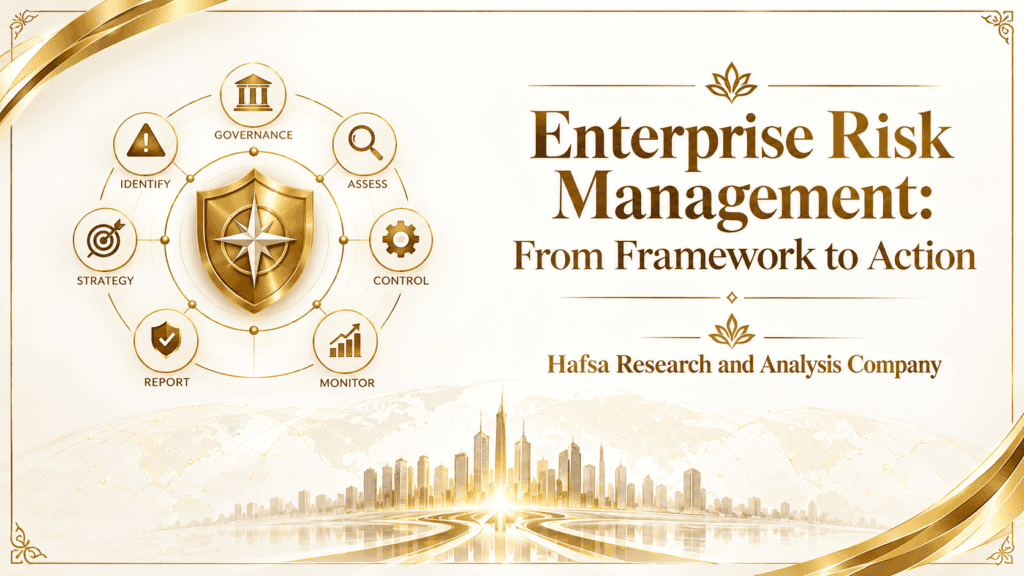
Enterprise Risk Management frameworks are not new. COSO has provided guidance since 2004, updated in 2017 to emphasize integrating risk with strategy and performance . ISO 31000 has offered principles-based guidance for over a decade . Yet organizations continue to struggle with the same fundamental problem: frameworks exist on paper, but risk thinking does not permeate decision-making.
The Microsoft case illustrates this starkly. Despite having ERM structures in place, the Cyber Safety Review Board found that Microsoft’s operational and strategic decisions “pointed to a corporate culture that deprioritized both enterprise security investments and rigorous risk management” . CEO Satya Nadella himself acknowledged that security was not a companywide commitment, requiring a complete rebuild of Microsoft’s approach .
The lesson is unambiguous: a framework alone cannot drive results. ERM succeeds or fails based on whether it is embedded into how decisions are actually made.
Solution 1: Understand What Each Framework Is Designed to Do
COSO ERM is primarily used to analyze and monitor risks at the corporate level, aligning risk management with strategic objectives . Its 2017 update emphasizes considering risk in both strategy-setting and performance-driving .
ISO 31000 is an international standard providing principles and guidelines for risk management. It is not certifiable but provides a framework for contextualizing risk management to any organization . La Poste, the major French public company, adopted ISO 31000 in 2015 to manage its complex multi-business model, using the guideline to help each branch structure its own risk management .
RIMS Risk Maturity Model assesses risk maturity across five pillars and 35 attributes, providing a diagnostic tool for continuous improvement .
Basel II/III frameworks are designed for financial institutions, focusing on risk-based capital requirements through three mutually reinforcing pillars: minimum capital requirements, supervisory review, and market discipline .
OCEG GRC Capability Model integrates governance, risk, compliance, ethics, and IT into a unified approach, teaching professionals how to achieve “Principled Performance” .
FERMA Framework focuses on European risk management, with a 2026 white paper urging a shift from threat-focused to value-creating risk management .
Action step: Assess which framework aligns with your organization’s complexity, sector, and regulatory requirements. Do not adopt multiple frameworks simultaneously without clear rationale—this creates duplication rather than integration.
Solution 2: Move from Risk Registers to Strategic Dashboards
A well-structured risk register is more than a list of exposures. It is a live strategic dashboard that helps executives prioritize decisions, track accountability, and spot opportunities hidden within uncertainty .
La Poste’s approach demonstrates this principle. The CEO and executive team used the risk register to align strategic priorities across divisions, empowering each branch to build its own risk framework guided by ISO 31000 principles. The result was a more agile, transparent, and resilient enterprise capable of adapting to regulatory changes, technological shifts, and service delivery risks in real time .
FERMA’s 2026 white paper pushes further, calling for companies to maintain “Risk Universes”—structured frameworks defining the full scope of risk categories—and to integrate opportunity identification within the ERM process, shifting from purely defensive to value-creating .
Action step: Review your risk register. Does it track ownership and accountability across business units? Does it identify opportunities, not just threats? If not, redesign it as a strategic dashboard for executive decision-making.
Solution 3: Address the Culture Gap Before It Becomes a Crisis
The Microsoft case remains the definitive cautionary tale. The CSRB found a “cascade of avoidable errors” including failure to detect the compromise of cryptographic keys, reliance on a customer to identify anomalies rather than detecting the breach independently, and slow correction of inaccurate public statements .
The board recommended that Microsoft’s CEO and directors “directly focus on the company’s security culture” and “deprioritize feature developments until substantial security improvements have been made” .
Rauf Aslam Butt’s observation is directly relevant: leadership commitment is essential, otherwise ERM becomes a “checklist exercise” rather than a strategic driver.
Action step: Assess whether your board and executive team treat risk as a strategic discipline or a compliance obligation. If risk discussions focus on register completion rather than decision quality, the culture gap is real—and it will surface during the next crisis.
Executive Checklist: ERM Effectiveness
Framework Alignment:
- □ Select framework(s) aligned with sector and complexity
- □ Avoid duplication across multiple frameworks
Strategic Integration:
- □ Redesign risk register as strategic dashboard
- □ Track ownership and accountability across business units
- □ Integrate opportunity identification within ERM process
Culture & Governance:
- □ Ensure board and executive commitment to risk as strategic discipline
- □ Assess whether risk discussions influence decision-making
- □ Address culture gaps before they surface in crisis
Continuous Improvement:
- □ Use RIMS RMM or equivalent to assess maturity
- □ Track progress against defined maturity targets
- □ Update risk frameworks as business environment evolves
Closing Thought
ERM’s true value lies not in its documentation but in its implementation, culture, and continuous evolution. Organizations that successfully integrate risk management into decision-making gain a competitive advantage by anticipating uncertainties rather than reacting to them.
The distinction between success and failure in ERM adoption comes down to leadership commitment and organizational mindset. A framework alone cannot drive results—it must be supported by a strong risk culture, continuous monitoring, and adaptability to changing environments.
As FERMA’s chief executive Laurent Nihoul concluded: “Risk management is not merely a defensive mechanism, but an integrated system that both protects and enables value creation” .
The question for every board and executive team is direct: Is your ERM framework documenting risk—or managing it?
Prepared by Hafsa Research and Analysis Company