
Prepared by Hafsa Research and Analysis Company
The Core Shift: Greenwashing Is Now a Quantifiable Financial Risk
Greenwashing is no longer merely a public relations concern. It has become a governance failure, a financial reporting exposure, and an enforcement target. The data emerging from 2026 makes this unambiguous.
A landmark study published in PLOS Climate in April 2026 analyzed 1,233 environmental claims from 33 of the world’s largest meat and dairy companies. The findings: 98% (1,213 claims) could be categorized as greenwashing—relating to vague promises, unverifiable future projections, or claims without supporting evidence. Only 29% of claims (356) offered any supporting evidence, and scholarly scientific evidence was provided for just three claims.
This is not an isolated sector problem. RepRisk data shows greenwashing incidents remain most prevalent in Europe and North America, and regulatory enforcement is accelerating across jurisdictions. The question for boards and executives is no longer whether greenwashing poses a risk—it is whether their own disclosures would survive scrutiny.
Solution 1: Adopt IFRS S1 and S2 as Your Reporting Baseline
The ISSB’s IFRS S1 and IFRS S2 provide the global baseline for sustainability-related financial disclosures. IFRS S1 requires entities to disclose sustainability-related risks and opportunities that could reasonably be expected to affect prospects. IFRS S2 sets specific climate-related disclosure requirements.
The ISSB is actively supporting implementation through its Transition Implementation Group, which addresses practical application questions by drawing directly on the standards themselves. The ISSB has also confirmed it will proceed with standard-setting on nature-related risks and opportunities, supplementing IFRS S1 and S2 requirements.
Action step: Align your sustainability reporting with IFRS S1 and S2. Map existing disclosures against the standards’ requirements—governance, strategy, risk management, and metrics and targets. Identify gaps before regulators or investors do.
Solution 2: Build Board-Level Oversight with Structured Governance
The shift from disclosure to governance is now explicit. In March 2026, the UN Sustainable Stock Exchanges initiative, IFC, IFRS Foundation, and Chapter Zero Alliance launched Model Guidance for Board-Level Oversight of ISSB-aligned Sustainability Reporting.
The guidance provides a four-step framework for boards:
- Understand the impact of sustainability-related risks and opportunities
- Align governance structures, risk management, and internal processes
- Oversee execution, including controls and reporting systems
- Communicate clear and credible disclosures
The IFC’s corporate governance manager Charles Canfield framed the imperative directly: “Strong corporate governance is the foundation of sustainable and resilient capital markets. This guidance provides directors with a structured and actionable approach to fulfilling this responsibility”.
Action step: Review your board’s sustainability oversight against the Model Guidance’s four-step framework. If your board only receives sustainability reports after publication, the oversight is retrospective—not governance.
Solution 3: Prepare for Escalating Enforcement Across Jurisdictions
The regulatory landscape for greenwashing is fragmenting and tightening simultaneously. The EU’s Empowering Consumers for the Green Transition Directive applies from 27 September 2026, prohibiting green claims without specific and verifiable evidence and carbon-neutral claims based solely on offsetting.
In the UK, the Digital Markets, Competition & Consumers Act 2024 has applied since April 2025, with civil penalties of up to 10% of global turnover for misleading commercial practices. The FCA’s anti-greenwashing rule requires sustainability-related statements about financial products to be clear, fair, and not misleading.
In the US, California’s SB 253 and SB 261 impose emissions reporting requirements with penalties up to $500,000 per violation. The FTC Green Guides provide guidance, though they lack the force of law.
For EU companies specifically, the Corporate Sustainability Reporting Directive requires disclosures to be detailed, comparable, verifiable, and subject to assurance under European Sustainability Reporting Standards.
Action step: Map your disclosure footprint across every jurisdiction where you operate. A US-based manufacturer with European subsidiaries triggers EU obligations. A technology company selling into California faces state-level requirements. Compliance costs must be built into the reporting budget, not treated as contingency.
Solution 4: Use AI for Greenwashing Detection—and Prepare to Be Detected
Academic research is advancing rapidly in LLM-based greenwashing detection. A 2026 study developed an LLM-based agentic system that cross-references ESG reports with external sources to identify discrepancies and omissions. Another systematic review confirms that encoder-only models (BERT, RoBERTa) dominate classification tasks including greenwashing detection, while hybrid strategies integrating classification and generation are emerging.
The practical implication for preparers: AI tools are being developed for regulators, auditors, and investors to detect greenwashing. The Integrity Council for the Voluntary Carbon Market has documented that 50-90% of rainforest carbon credits issued by leading certification bodies did not represent genuine emission reductions.
Action step: Before making any environmental claim, test it against three questions: Is it verifiable by a third party? Does it exclude material negative impacts? Is it supported by data that would withstand AI-assisted scrutiny? If any answer is uncertain, either substantiate or retract.
Solution 5: Adopt Radical Transparency as Competitive Strategy
Counter-intuitively, the anti-greenwashing crackdown is creating competitive advantage for brands that embrace transparent, evidence-based communication—even when data reveals imperfections.
Patagonia publishes detailed environmental impact assessments for individual products, including negative findings. Allbirds publishes product-level carbon footprint data with full methodological documentation. Interface provides verified lifecycle assessment data for every product line and openly discusses limitations of its carbon reduction programs.
The lesson: regulatory compliance and brand trust are converging. Claims backed by transparent data and honest acknowledgment of limitations build more durable trust than aspirational marketing—and they are far less likely to trigger enforcement.
Action step: Audit your public sustainability claims. Replace aspirational language (“committed to sustainability”) with measurable statements (“reduced Scope 1 and 2 emissions by 15% against 2022 baseline, verified by [third party]”). Disclose what you have not yet achieved alongside what you have.
Executive Checklist: Greenwashing Prevention Readiness
Governance:
- □ Implement board-level oversight aligned with ISSB Model Guidance
- □ Establish internal controls over sustainability reporting
- □ Ensure consistency between sustainability reports, annual reports, and corporate communications
Reporting:
- □ Align disclosures with IFRS S1 and IFRS S2 requirements
- □ Obtain independent assurance over sustainability reports
- □ Report both achievements and ongoing challenges transparently
Claims Verification:
- □ Test every public environmental claim for verifiability
- □ Disclose Scope 3 emissions or explain exclusions
- □ Ensure carbon offsets meet ICVCM Core Carbon Principles
Enforcement Preparation:
- □ Map jurisdictional disclosure obligations
- □ Budget for compliance costs across all markets
- □ Train management on ethical ESG reporting practices
Closing Thought
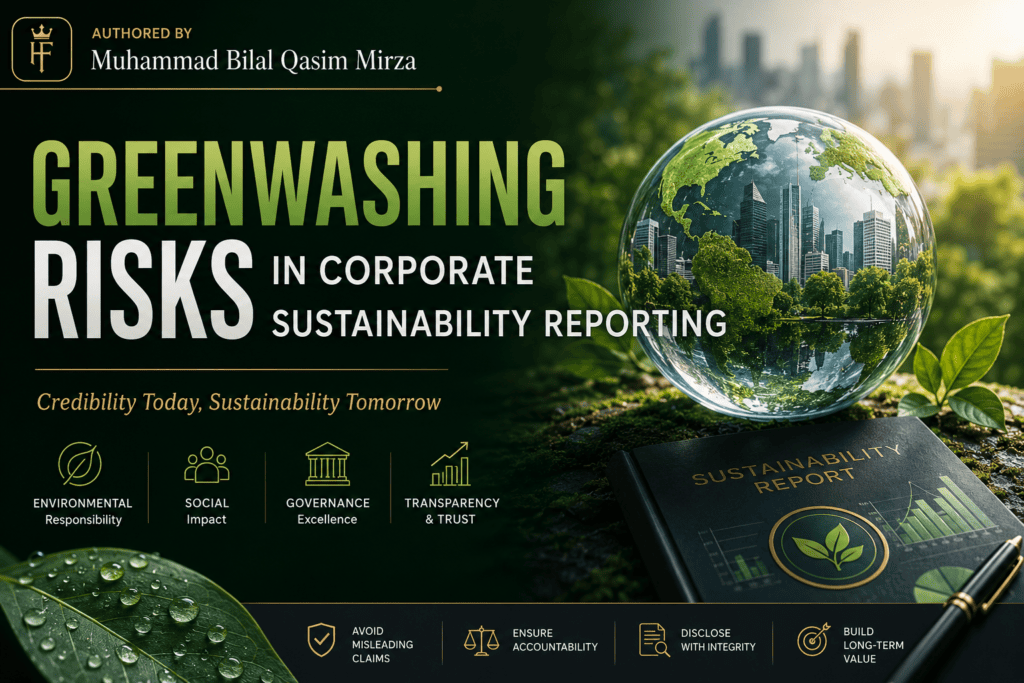
Greenwashing has evolved from a reputational concern to a governance, financial reporting, and enforcement risk. The PLOS Climate study’s finding—98% of claims from major meat and dairy companies classified as greenwashing—is a warning for every sector.
The path forward is not less disclosure. It is credible disclosure: claims backed by verifiable evidence, governance that ensures accuracy, and transparency that acknowledges limitations. Organizations that embrace this discipline will build lasting stakeholder trust and access sustainable finance. Those that continue to rely on aspirational marketing will face escalating legal, financial, and reputational consequences.
As the IFRS Foundation’s work with IFC and UN SSE demonstrates, the convergence of global standards, board-level governance, and practical implementation tools is creating a new reporting ecosystem. The question for every board is direct: Would your sustainability claims survive AI-assisted scrutiny?
Prepared by Hafsa Research and Analysis Company