

Prepared by Hafsa Research and Analysis Company
The Core Shift: Stability at the Top, Complexity Below
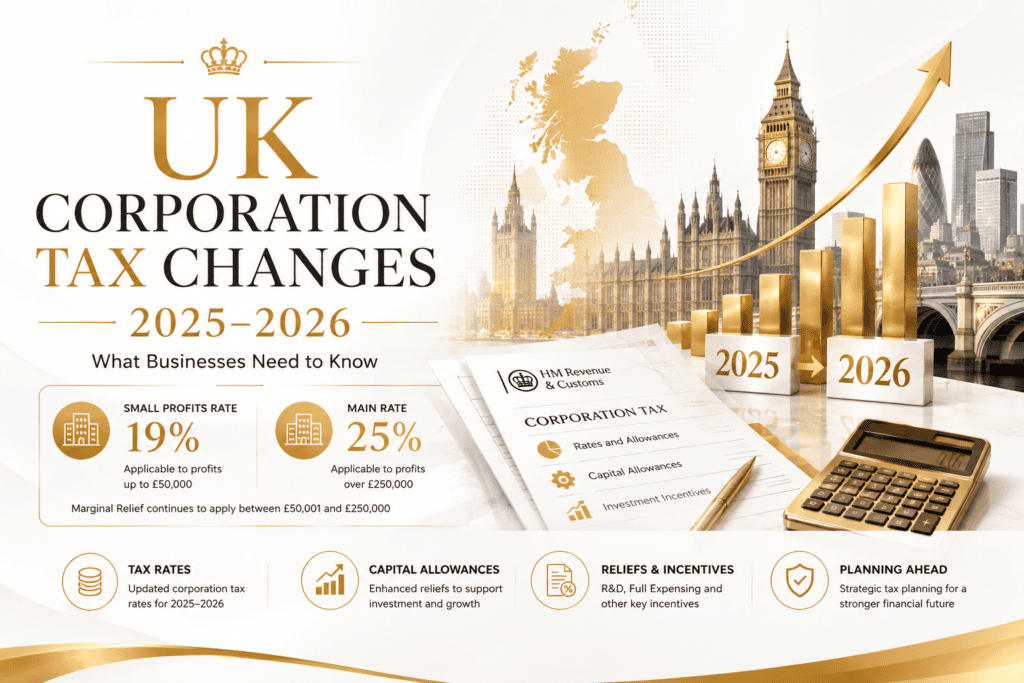
The UK’s 2025-2026 tax reforms can be summarized in two words: stability and complexity. The government has committed to freezing the main corporation tax rate at 25% until the end of this Parliament, with personal allowances and basic rate limits locked until 2031. This provides rare certainty for business planning.
But beneath the stability lies growing complexity. Personal income tax, dividend taxation, property income rates, capital allowances, corporate interest restriction, and the OECD Two-Pillar framework are all advancing simultaneously. Even with unchanged headline rates, effective tax burdens and compliance costs are rising.
As Colin Graham, Head of Tax Policy at PwC UK, observed: businesses need “stability and certainty” in UK tax policy—but frequent changes and complicated regulations are increasing compliance challenges for companies.
Solution 1: Account for the “Hidden Tax Rise” in Frozen Personal Allowances
The Personal Allowance is fixed at £12,570, the Basic Rate Limit at £37,700, and the Higher Rate Threshold at £50,270. These figures will remain unchanged until April 2031.
On the surface, this is “no change.” But factoring in inflation, the effective tax burden rises every year. Nominal wage growth pushes more employees into higher tax bands while allowances remain frozen. This is “fiscal drag”—a mechanism that increases tax revenue without new legislation.
Action step: For businesses with significant headcount, incorporate the fiscal drag effect into compensation planning. Real disposable income growth may lag nominal wage growth, affecting pay negotiations and retention strategies.
Solution 2: Prepare for Dividend Tax Increases from April 2026
From April 2026, dividend tax rates for basic and higher rate taxpayers will increase by 2 percentage points:
- Basic rate: 8.75% → 10.75%
- Higher rate: 33.75% → 35.75%
- Additional rate: unchanged
This change disproportionately affects owner-directors. Many UK SME owners take dividends as their primary income because dividends have historically carried lower National Insurance than salaries. The 2 percentage point increase directly reduces net income.
Action step: Owner-directors should review their salary-versus-dividend mix before April 2026. Where possible, consider accelerating dividend distributions before the rate increase. Evaluate whether pension contributions—typically tax-deductible—can optimize the overall tax position.
Solution 3: Capitalize on the New 40% First-Year Allowance from January 2026
This is the most attractive business tax incentive of the 2025-2026 reforms. From 1 January 2026, qualifying main-rate plant and machinery expenditure benefits from a 40% First-Year Allowance (FYA).
Key features:
- Applies to new and unused assets (not second-hand)
- Available to unincorporated businesses and partnerships, not just companies
- Leased assets now qualify (an extension of the existing full expensing regime)
- No annual cap (unlike the £1 million AIA)
But note: main-rate writing-down allowance (WDA) will decrease from 18% to 14% from April 2026. This means the annual tax relief on existing pools—where FYA is not claimed—will slow.
Action step: If your business plans equipment investment in 2026 (technology upgrades, automation, machinery), ensure expenditure occurs after 1 January 2026 to qualify for the 40% FYA. Recalculate capital expenditure budgets—the combined effect of FYA and reduced WDA requires precise modeling.
Solution 4: Monitor Property Income Tax Rates for 2027-2028
From the 2027-2028 tax year, property income will be subject to separate rates: 22% basic, 42% higher, 47% additional. These are 2 percentage points above ordinary income rates.
This change aims to align the tax treatment of “asset income” more closely with “labour income.” For businesses or individuals with substantial property portfolios, the impact may be significant.
Action step: If your business holds investment property, or owner-directors receive rental income, reassess holding structures before 2027. Would corporate ownership be more advantageous? Should rental income recognition be accelerated or deferred? These require professional tax modeling.
Solution 5: Understand the Corporate Interest Restriction (CIR) Simplification
The CIR rules limit large businesses’ ability to deduct excessive interest, applying to groups with net financing costs exceeding £2 million.
The 2026 changes are primarily administrative simplifications:
- Removed time limits on appointing a reporting company
- Allowed retrospective appointment (back to periods ending after 31 March 2024)
- Reporting company appointments no longer automatically roll over—they must be reauthorized each period
- Failure to validly appoint a reporting company before filing triggers a £1,000 penalty
Action step: If your group is subject to CIR, ensure a reporting company is validly appointed for each period (with authorization from more than 50% of group members). Use the retrospective appointment window to resolve historical non-compliance.
Executive Checklist: UK Corporation Tax Reform Readiness
Rates & Allowances:
- □ Incorporate fiscal drag effects into compensation planning
- □ Assess dividend tax increase impact on owner-director remuneration mix
Capital Investment:
- □ Ensure qualifying 2026 equipment expenditure occurs after 1 January
- □ Model combined effect of 40% FYA and 14% WDA
Property & Investment Income:
- □ Assess 2027 property income rate impact on portfolios
- □ Consider potential holding structure optimization
Compliance & Governance:
- □ Confirm valid CIR reporting company appointment each period
- □ Assess OECD Pillar 2 global minimum tax filing obligations (if applicable)
Strategic Planning:
- □ Build tax compliance costs into annual budgets
- □ Engage tax advisers for forward-looking planning, not retrospective fixes
Closing Thought
The UK’s 2025-2026 corporation tax reforms follow a clear pattern: stable headline rates, rising effective burdens; expanded incentives, increased compliance complexity.
For businesses operating in the UK—whether domestic SMEs or multinational subsidiaries—the core challenge is no longer “What is the tax rate?” It is “How do we optimize our overall tax position within complex rules?”
As Dan Neidle has argued, the UK corporation tax system is “one of the least competitive in the world” because of its complexity. Yet the combination of 40% FYA and a 25% main rate provides meaningful incentives for capital-intensive investment.
The question is whether your business can complete the modeling and planning before the rules take effect—rather than reacting at the filing deadline.
Prepared by Hafsa Research and Analysis Company