

Prepared by Hafsa Research and Analysis Company
The Core Problem: Effort Is Being Mistaken for Value
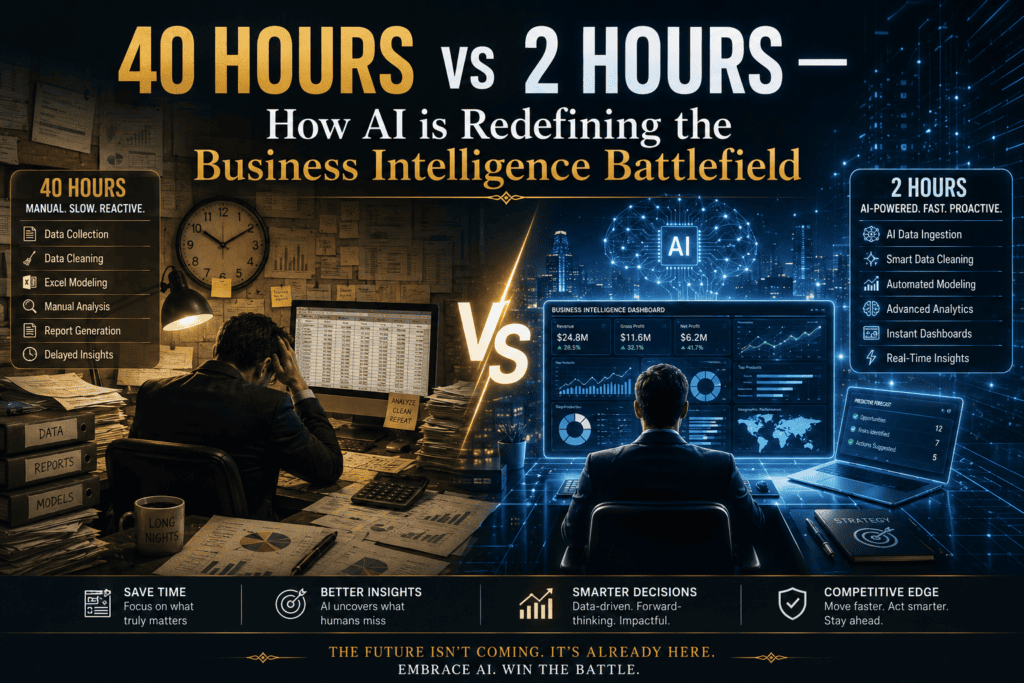
Most businesses today operate under layers of inefficiency—outdated reporting systems, manual approvals, and unstructured data flows. It is not uncommon for management teams to spend 40+ hours reconciling reports, verifying accounts, or manually tracking KPIs that could be identified in under 2 hours with intelligent automation.
This is not a technology problem. It is a management problem. The hours are being spent—but not on judgement, strategy, or value creation. They are being spent on work that machines now do better, faster, and with fewer errors.
The question for executives is direct: If your business operations were analyzed by AI today, would it expose inefficiency or excellence?
Solution 1: Diagnose Before You Automate
The most common mistake in automation initiatives is deploying tools before understanding the problem. A full-spectrum business analysis typically uncovers recurring findings across three domains:
Financial & Operational:
- Non-standardized accounting practices — reports differ across departments, creating inconsistent visibility
- Overstated revenues or receivables — no real-time aging analysis or provisioning
- Inefficient asset management — machinery, vehicles, and equipment not monitored for depreciation or utilization
- Weak cost controls — no clear link between spending and value creation
- Data silos — each function maintains its own data universe, blocking enterprise-wide insight
- Manual audit trails — hours wasted tracing transactions without automated workflows
Governance & Policy:
- No delegation of authority framework — unclear accountability in approvals
- Policy absence or redundancy — procurement, HR, and payment cycles run without guidance
- Risk management gaps — no central register to track, quantify, or prioritise risks
- Vendor dependencies — over-reliance on single suppliers without periodic review
Digital & Strategic:
- Outdated or non-integrated ERP — systems fail to communicate, resulting in poor analytics
- Underutilized data assets — customer and transaction data not recognized as strategic assets
- No AI or automation deployment — repetitive manual work consumes strategic time
- No business intelligence layer — lack of dashboards, visualization, and real-time insight
- Reactive culture — teams respond to crises rather than predict and prevent them
Action step: Before investing in any automation tool, conduct a structured diagnostic across these three domains. Document where time is actually spent. If you cannot quantify the hours lost to reconciliation, verification, and manual tracking, you are not ready to automate—you are guessing.
Solution 2: Target the Highest-Volume, Highest-Error Processes First
Not all processes deserve automation. The priority should be processes that are:
- High volume (repetitive, transactional)
- High error risk (manual data entry, reconciliation)
- High time cost (consuming skilled professional hours)
Financial reconciliation, accounts payable matching, expense categorization, and KPI tracking are common starting points. These are also processes where AI delivers measurable, rapid returns.
One mid-sized firm that adopted AI bookkeeping software to automate invoice processing achieved:
- 75% reduction in processing time
- 90% fewer data entry errors
- 30% of staff time reallocated to advisory and compliance tasks
- Full ROI within nine months
Action step: Rank your processes by volume, error frequency, and time cost. Select the top three as pilot candidates. Define success metrics before deployment—processing time, error rate, and hours reallocated to higher-value work.
Solution 3: Move from Reactive Reporting to Predictive Governance
Traditional businesses rely on reports after results are out. AI-driven businesses monitor live signals to act before impact.
The difference is fundamental:
| Traditional | AI-Driven |
|---|---|
| Finding a loss | Preventing a loss |
| Reporting a deviation | Predicting a deviation |
| Explaining performance | Engineering performance |
AI now enables:
- Real-time mapping of financial and operational gaps
- Anomaly detection in expenses, procurement, and revenue recognition
- Liquidity stress and risk cluster prediction before materialization
- Automated compliance and reporting that is governance-ready
- Transformation of static data into actionable strategic insight
Action step: Identify one decision you currently make retrospectively—such as monthly variance analysis or quarterly risk review. Build a real-time signal for that decision. For example, if you review receivables aging monthly, implement daily monitoring of payment behaviour and flag deviations immediately.
Solution 4: Preserve Human Judgement at the Decision Layer
AI brings precision. Wisdom still belongs to humans. Strategy, ethics, and leadership are not programmable.
AI can forecast. Only leadership can decide. The most effective operating model is not full automation—it is augmented intelligence: AI handles repetitive tasks, anomaly flagging, pattern recognition, and data standardization; humans provide judgment, oversight, interpretation, and strategic decisions.
The practical implication: define human checkpoints for every AI-assisted output that influences material decisions. If the AI cannot explain how it arrived at a conclusion, it is not ready for production.
Action step: For each automated process, define the human review point. Document the basis for accepting or rejecting AI outputs. The objective is not to eliminate human involvement—it is to ensure human involvement is focused where it adds most value.
Executive Checklist: From 40 Hours to 2
Diagnose:
- □ Conduct full-spectrum analysis across financial, governance, and digital domains
- □ Quantify hours lost to reconciliation, verification, and manual tracking
- □ Identify data silos and integration gaps
Prioritize:
- □ Rank processes by volume, error risk, and time cost
- □ Select top three pilot candidates
- □ Define success metrics before deployment
Automate:
- □ Deploy AI for high-volume, high-error processes first
- □ Build real-time signals for retrospective decisions
- □ Create business intelligence dashboards for executive visibility
Govern:
- □ Define human checkpoints for AI-assisted decisions
- □ Document review rationale and approval trails
- □ Train teams on recognizing AI limitations and exercising professional scepticism
Measure:
- □ Track processing time reduction
- □ Monitor error rate improvement
- □ Quantify hours reallocated to strategic work
Closing Thought
The businesses of tomorrow will not be defined by how much they work—but by how intelligently they operate.
The 40-hour problem is not solved by working harder. It is solved by recognizing that effort, without intelligence, is merely activity. AI does not replace human judgement. It liberates human judgement from the work that never required it.
The question for every executive team is direct: What would your business look like if your best people spent their time on the decisions that actually matter?
Prepared by Hafsa Research and Analysis Company