
Researched by Hafsa Research and Analysis Company
Introduction
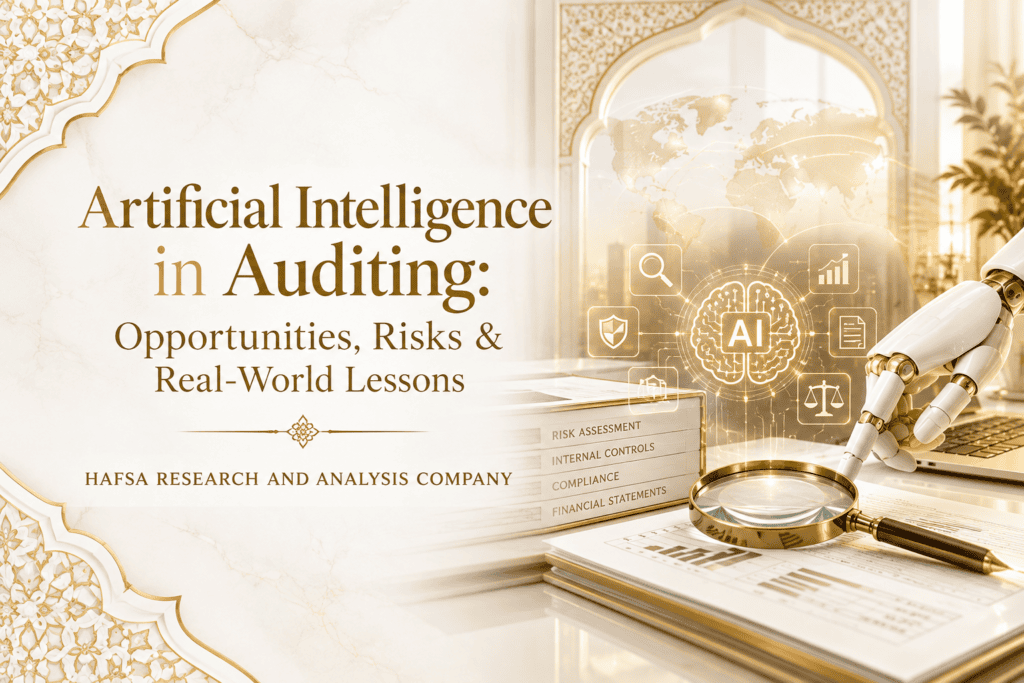
Artificial Intelligence (AI) is transforming the audit profession — reshaping how internal and external audits are planned, executed, and reported.
From risk analysis and transaction testing to report drafting, AI tools offer unprecedented efficiency and insight.
Yet, as the recent Deloitte controversy reminds us, these benefits come with equally serious risks.
This article explores the pros and cons of AI in auditing, supported by real-life success and failure cases from global firms.
The Pros: How AI Is Revolutionizing Auditing
1. Speed, Efficiency & Automation
AI reduces time-consuming manual work by automating tasks such as data extraction, control testing, and document verification.
For internal audit teams, this means faster reporting; for external auditors, it means larger data coverage and better accuracy.
🟢 Success Example — KPMG & Microsoft Partnership
KPMG integrated Microsoft’s Azure AI into its global audit platform “Clara.”
This system automates data ingestion, anomaly detection, and trend analysis — reducing manual review time by 40% while improving precision across 80+ countries.
2. Enhanced Fraud & Risk Detection
AI detects irregular patterns and fraudulent entries faster than traditional audit sampling.
Machine learning models continuously learn from previous audit results, improving prediction accuracy.
🟢 Success Example — PwC’s “Halo for Journals” Tool
PwC developed the HALO platform that analyzes full general-ledger populations for anomalies.
It helped uncover material misstatements in a Fortune 500 client’s ledger — months before a manual review would have detected them.
3. Full Population Testing & Accuracy
AI enables auditors to review entire datasets instead of limited samples.
This increases coverage and reduces the likelihood of missing significant misstatements.
🟢 Success Example — EY Canvas System
EY’s audit platform “Canvas” uses AI and data analytics to perform population-wide testing, improving risk assessment and reducing audit errors across large multinationals.
4. Proactive, Real-Time Monitoring
Internal audit teams can establish continuous control monitoring systems using AI — allowing them to identify risks as they occur.
This turns auditing from a reactive to a proactive process.
🟢 Success Example — Siemens Internal Audit
Siemens implemented an AI-based control monitoring framework that reduced its internal audit cycle time by 40%, while enhancing compliance accuracy and control validation.
The Cons: When AI Goes Wrong
1. Data Bias & Quality Risks
AI is only as good as the data it’s trained on.
If historical data contains bias or inconsistencies, AI may amplify these errors — producing misleading insights or false audit conclusions.
2. Explain ability & Transparency
AI models can act as “black boxes,” making it difficult for auditors to explain how conclusions were reached — a critical issue for regulatory acceptance and stakeholder trust.
3. Overreliance on AI & Judgment Erosion
When auditors depend too heavily on automated results, they risk losing professional skepticism — one of the cornerstones of auditing ethics and quality.
Real-World Failures: Lessons from the Field
🔴 Case Study 1 — Deloitte’s AI Report Refund (Australia, 2025)
Deloitte produced a 237-page AI-assisted report for the Australian government worth AU$440,000, which later contained fabricated citations and quotes generated by AI.
After media scrutiny, Deloitte refunded part of the payment and revised the report.
This incident highlighted the dangers of using AI without strict human validation, transparency, and disclosure controls.
🔴 Case Study 2 — EY’s 2020 Wire card Audit Controversy
Although not directly caused by AI, this case revealed how automation and procedural overreliance can overlook fraud.
EY was criticized for failing to detect €1.9 billion in missing cash from Wire card AG — despite having advanced data tools.
It reminded firms that technology cannot replace professional skepticism and real-world verification.
Lessons & Best Practices
✅ Combine Human Judgment with AI Outputs
AI should support, not replace, professional judgment and risk assessment.
✅ Validate Data & Models Regularly
Ensure data integrity and retrain AI models to prevent bias or drift.
✅ Maintain Explain ability & Audit Trail
All AI results must be explainable, reproducible, and reviewable by human auditors.
✅ Strengthen Governance & Oversight
Define clear accountability, disclosure policies, and ethical use frameworks for AI tools.
Conclusion
Artificial Intelligence is reshaping how audits are performed — from internal control testing to external reporting.
While firms like PwC, EY, and KPMG have showcased the success of AI-driven audits, Deloitte’s AI misstep stands as a cautionary tale about the dangers of unchecked automation.
The path forward lies in balanced integration — using AI as a powerful partner, not a replacement, to human expertise, ethics, and professional skepticism.
Researched by Hafsa Research and Analysis Company