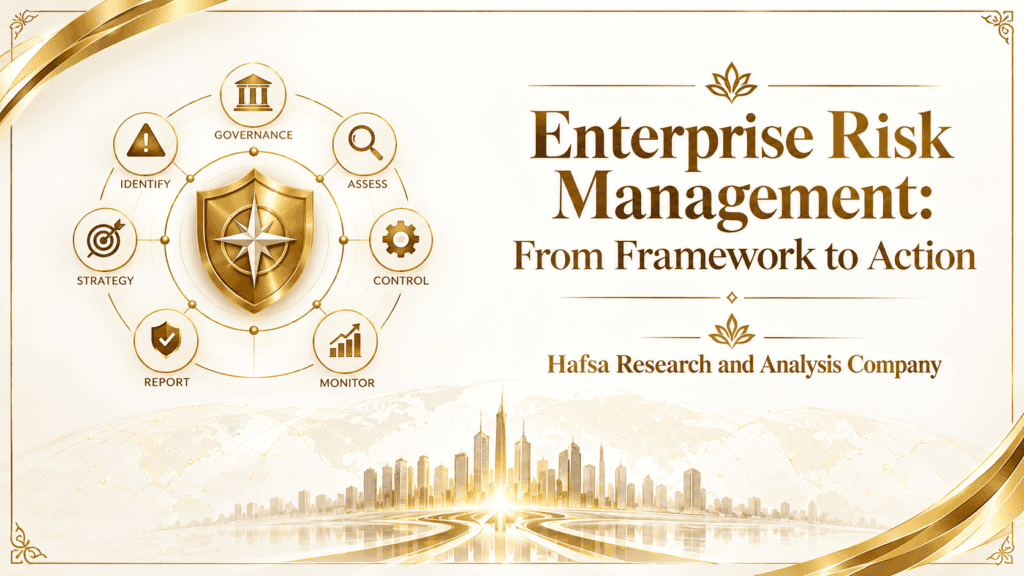

Enterprise Risk Management (ERM) frameworks are structured systems designed to identify, assess, monitor, and manage risks that may affect an organization’s ability to achieve its objectives. These risks exist at every level of the organization and may be financial, operational, strategic, or compliance-related. A well-implemented ERM framework ensures that risks are not only identified but also addressed proactively, enabling organizations to strengthen resilience and sustain long-term growth.
Types of Enterprise Risk Management Frameworks
There are several widely recognized ERM frameworks, each serving a specific purpose:
- COSO ERM Framework
Primarily used to analyze and monitor risks at the corporate level, aligning risk management with strategic objectives. - ISO 31000
An international standard providing principles and guidelines for effective risk management across all industries. - RIMS Risk Maturity Model (RMM)
Helps organizations assess their risk maturity level and enhance their overall risk management capabilities. - Basel II/III Frameworks
Designed for financial institutions, focusing on risk-based capital requirements and financial stability. - OCEG GRC Framework
Integrates governance, risk, and compliance into a unified approach for better organizational control. - FERMA Framework
Focuses on operational and financial risk management, supporting organizations in building comprehensive ERM systems.
Impact of ERM Frameworks on Organizations
- COSO ERM
Enhances internal controls, uncovers fraud, aligns risk with strategy, and improves overall performance and investor confidence. - ISO 31000
Promotes a risk-aware culture, enhances organizational resilience, and supports global regulatory compliance through a flexible approach. - RIMS Risk Maturity Model
Acts as a diagnostic tool that encourages continuous improvement, better communication, and integration of risk into decision-making. - Basel II/III
Strengthens financial stability by enforcing capital adequacy, transparency, and risk-sensitive decision-making.
Real-Life Applications and Outcomes
- Microsoft (2024)
Criticized by the Cyber Safety Review Board for weak risk culture despite having ERM structures.
Insight: Frameworks must be embedded into decision-making, not just documented. - La Poste (France)
Adopted ISO 31000 during digital transformation.
Outcome: Improved resilience, adaptability, and cross-functional risk management. - Global Banks Post-2008 Financial Crisis
Adopted GRC frameworks to integrate compliance, audit, and risk.
Outcome: Reduced duplication, improved accountability, and strengthened governance.
Insights from Industry Executives
- COSO ERM
Rauf Aslam Butt (SSGC) emphasized that leadership commitment is essential; otherwise, ERM becomes a “checklist exercise” rather than a strategic driver. - ISO 31000
Alex Dali highlighted its flexibility, allowing organizations to tailor risk management practices to their specific needs.
Failures and Lessons Learned
- COSO ERM (Microsoft Case)
Failure to embed risk culture into daily operations rendered the framework ineffective.
Lesson: Culture drives the success of frameworks. - ISO 31000 (Public Sector Agencies, Australia)
Treated as a compliance exercise with outdated risk registers.
Lesson: Continuous monitoring and engagement are critical.
Success Stories
- General Electric (GE)
Successfully implemented COSO ERM to align risk with strategic planning.
Impact: Reduced uncertainties and enhanced investor confidence. - La Poste (France)
Effectively used ISO 31000 to navigate digital transformation.
Impact: Strengthened stakeholder trust and operational resilience.
Closing Thoughts
Enterprise Risk Management is not merely a regulatory requirement or a theoretical framework—it is a strategic necessity. The true value of ERM lies not in its documentation but in its implementation, culture, and continuous evolution. Organizations that successfully integrate risk management into their decision-making processes gain a significant competitive advantage by anticipating uncertainties rather than reacting to them.
However, the distinction between success and failure in ERM adoption often comes down to leadership commitment and organizational mindset. A framework alone cannot drive results; it must be supported by a strong risk culture, continuous monitoring, and adaptability to changing environments.
As businesses operate in increasingly complex and uncertain landscapes, ERM frameworks will continue to play a pivotal role in ensuring sustainability, resilience, and long-term value creation.
Authored By
Muhammad Bilal Qasim Mirza