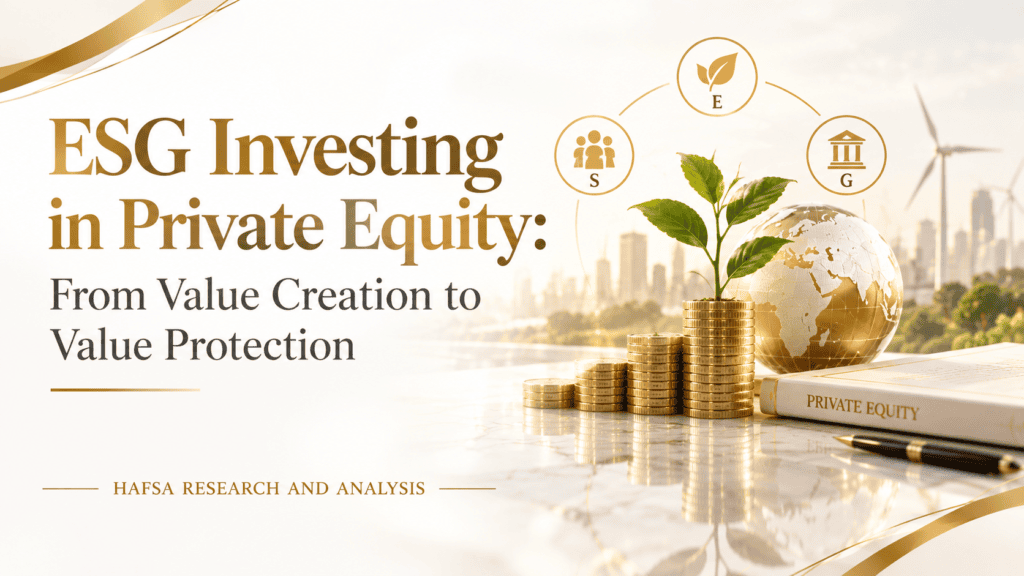

How Environmental, Social, and Governance Factors Are Reshaping Private Equity Investment Decisions
Researched by Hafsa Research and Analysis Company
1. Introduction
Environmental, Social, and Governance (ESG) investing has evolved from a voluntary corporate initiative into one of the most influential investment frameworks in modern finance. While ESG was once primarily associated with publicly traded companies, private equity (PE) firms have increasingly integrated ESG considerations into every stage of the investment lifecycle—from sourcing deals and conducting due diligence to portfolio management and exit strategies.
Private equity firms control trillions of dollars in assets globally and often have significant influence over the strategic direction of their portfolio companies. Unlike public investors, PE firms have direct governance rights, board representation, and operational control, allowing them to implement ESG improvements more effectively.
Today, investors no longer ask whether ESG creates value; instead, they ask how much value poor ESG management destroys.
Institutional investors, sovereign wealth funds, pension funds, insurance companies, family offices, and development finance institutions increasingly require ESG integration before committing capital to private equity funds. Consequently, ESG has become both a risk management tool and a competitive advantage.
2. Relationship Between ESG and Private Equity
Private equity firms seek long-term value creation by acquiring companies, improving operations, and selling them at higher valuations.
ESG naturally complements this objective because many operational improvements directly influence financial performance.
Environmental Factors
- Carbon emissions
- Energy efficiency
- Renewable energy adoption
- Waste management
- Water conservation
- Climate resilience
- Sustainable supply chains
Environmental improvements often reduce operating expenses while preparing companies for future environmental regulations.
Social Factors
Social considerations include:
- Employee safety
- Diversity and inclusion
- Human rights
- Customer privacy
- Labor standards
- Employee wellbeing
- Community engagement
Companies with strong workplace cultures generally experience:
- Lower turnover
- Higher productivity
- Better innovation
- Reduced litigation risk
Governance Factors
Governance remains one of the most influential drivers of PE returns.
It includes:
- Board independence
- Internal controls
- Executive compensation
- Risk management
- Anti-corruption policies
- Ethical leadership
- Transparent reporting
Private equity firms frequently strengthen governance immediately after acquisition because governance improvements often unlock operational efficiencies.
ESG Throughout the Private Equity Lifecycle
| Stage | ESG Focus |
| Deal sourcing | ESG screening |
| Due diligence | ESG risk assessment |
| Acquisition | ESG improvement plan |
| Ownership | Operational ESG implementation |
| Exit | ESG reporting increases valuation |
ESG is no longer an isolated compliance exercise—it has become integrated into investment strategy.
3. Why ESG Is Rising in the Private Equity Sector
Several global trends explain ESG’s rapid growth.
A. Investor Demand
Large institutional investors increasingly require ESG integration.
Examples include:
- Pension funds
- Insurance companies
- Sovereign wealth funds
- University endowments
Many investors now reject PE funds lacking robust ESG policies.
B. Regulatory Pressure
Governments worldwide have introduced ESG disclosure requirements.
Examples include:
- EU Sustainable Finance Disclosure Regulation (SFDR)
- Corporate Sustainability Reporting Directive (CSRD)
- UK Sustainability Disclosure Requirements
- Climate disclosure rules in multiple jurisdictions
Private companies increasingly face similar expectations as public firms.
C. Climate Risk
Extreme weather events have demonstrated that climate risk directly affects business value through:
- Supply chain disruptions
- Insurance costs
- Infrastructure damage
- Regulatory changes
Climate risk is now considered financial risk.
D. Consumer Expectations
Customers increasingly prefer sustainable brands.
Companies demonstrating genuine ESG commitment often achieve:
- Greater customer loyalty
- Higher pricing power
- Enhanced brand reputation
E. Talent Attraction
Younger professionals increasingly seek employers aligned with sustainability values.
Strong ESG performance assists in attracting and retaining skilled employees.
4. Executive Interviews (Real Companies)
Larry Fink — Chairman and CEO, BlackRock
Larry Fink has repeatedly stated in his annual CEO letters that sustainability is becoming a defining factor in long-term investing. He emphasizes that climate risk is investment risk and that companies with strong governance and sustainability practices are generally better positioned for durable value creation.
BlackRock has encouraged companies to improve ESG disclosures and long-term resilience rather than focusing solely on short-term earnings.
Bill Anderson — CEO, Bayer AG
Bill Anderson has discussed integrating sustainability into Bayer’s innovation strategy, emphasizing climate-smart agriculture, healthcare access, and responsible governance as long-term business priorities. He has highlighted that sustainability and innovation should reinforce one another rather than compete.
Jesper Brodin — CEO, Ingka Group (IKEA)
Jesper Brodin has consistently emphasized sustainability as central to IKEA’s business model, focusing on circular economy initiatives, renewable energy investments, and reducing carbon emissions while maintaining affordability for customers.
Emmanuel Faber — Former CEO, Danone
Emmanuel Faber advocated for integrating social purpose with financial performance. Under his leadership, Danone pursued initiatives focused on responsible sourcing, employee welfare, and environmental sustainability, arguing that long-term value creation depends on balancing stakeholder interests with shareholder returns.
David Blood — Senior Partner, Generation Investment Management
David Blood has argued that sustainability is one of the largest investment opportunities of the coming decades. He has stressed that companies effectively managing ESG risks are generally more resilient and better positioned for long-term growth.
5. Real-Life Cases
Case 1: KKR – Green Portfolio Program
KKR introduced its Green Portfolio Program to help portfolio companies improve environmental performance by reducing energy use, emissions, and waste.
Results reported over multiple years included:
- Significant energy savings
- Reduced greenhouse gas emissions
- Lower operating costs
- Improved financial performance
The initiative demonstrated that environmental improvements can generate measurable financial returns.
Case 2: EQT
EQT integrates ESG assessments into investment decisions and ownership plans.
The firm evaluates:
- Carbon footprint
- Cybersecurity
- Human capital
- Governance quality
ESG performance forms part of management discussions throughout ownership.
Case 3: Bain Capital
Bain Capital established formal ESG frameworks across portfolio companies, focusing on operational improvements, workforce development, and governance enhancements. ESG metrics are increasingly embedded into value creation plans.
Case 4: Carlyle Group
The Carlyle Group incorporates climate resilience, governance, and diversity initiatives into portfolio management. ESG considerations influence investment committee discussions and long-term strategic planning.
6. Successful vs. Failed ESG Integration
| Successful ESG Integration | Failed ESG Integration |
| Strong governance | Weak board oversight |
| Transparent reporting | Misleading disclosures |
| Long-term sustainability | Short-term public relations |
| Lower operational risk | Regulatory investigations |
| Strong employee engagement | High employee turnover |
| Higher investor confidence | Loss of investor trust |
| Better exit valuation | Lower acquisition multiples |
Example of Success
KKR’s Green Portfolio Program demonstrated measurable operational savings alongside environmental improvements, supporting stronger financial outcomes and investor confidence.
Example of Failure
Several companies have faced allegations of overstating sustainability credentials. When environmental claims are not supported by evidence, organizations can experience regulatory scrutiny, reputational damage, and reduced investor confidence, illustrating the financial risks associated with weak ESG governance.
7. Present Impact vs. Future Impact
Present
Today’s ESG investing influences:
- Due diligence
- Financing conditions
- Cost of capital
- Investor selection
- Reputation management
- Operational efficiency
Many lenders and investors now incorporate ESG assessments into credit and investment decisions.
Future
Over the next decade, ESG is expected to become increasingly integrated with:
- Artificial Intelligence
- Climate analytics
- Carbon accounting
- Biodiversity reporting
- Supply chain transparency
- Real-time sustainability data
- Integrated financial and sustainability reporting
Private equity firms are likely to use advanced data analytics to monitor ESG performance continuously across portfolio companies.
8. The Importance of ESG When a Target Company Is Greenwashing: Impact on Valuation
Greenwashing refers to the practice of portraying a company as more environmentally or socially responsible than its actual performance supports. For private equity investors, identifying greenwashing during due diligence is essential because inaccurate ESG claims can materially affect enterprise value.
Key Risks of Greenwashing
- Regulatory investigations and enforcement actions.
- Litigation from investors, customers, or other stakeholders.
- Reputational damage leading to reduced sales or customer trust.
- Increased compliance and remediation costs.
- Difficulty securing financing from ESG-focused lenders or investors.
- Lower exit multiples due to heightened perceived risk.
Valuation Implications
When evidence of greenwashing is uncovered, PE firms may respond by:
- Reducing valuation multiples to reflect additional risk.
- Increasing discount rates in discounted cash flow (DCF) models.
- Building higher contingency reserves or indemnity provisions into transaction agreements.
- Delaying or abandoning acquisitions until ESG issues are resolved.
- Requiring post-acquisition remediation plans before committing capital.
Conversely, companies with credible ESG reporting, robust governance, and independently verified sustainability metrics often receive stronger investor confidence and may achieve more favorable financing terms and exit valuations.
Due Diligence Focus Areas
Private equity investors increasingly verify:
- Carbon emissions data.
- Supply chain practices.
- Labor and human rights compliance.
- Governance controls.
- Third-party sustainability certifications.
- Consistency between public ESG claims and operational performance.
The objective is to distinguish genuine value creation from marketing-driven narratives.
9. Prospects of ESG with Private Equity and Its Impact on Global Business
The long-term outlook for ESG within private equity remains strong, driven by investor expectations, regulation, and the growing recognition that sustainability factors influence financial performance.
Key Trends
- Greater use of ESG-linked financing and sustainability-linked loans.
- Increased adoption of standardized ESG reporting frameworks.
- Integration of climate scenario analysis into investment decisions.
- Expansion of investments in renewable energy, healthcare innovation, circular economy businesses, and sustainable infrastructure.
- Enhanced use of artificial intelligence to monitor ESG performance.
- Stronger collaboration between investors, regulators, and portfolio companies to improve transparency.
As private equity continues to shape industries through active ownership, ESG integration is expected to influence how businesses allocate capital, manage risk, innovate, and compete globally. Firms that embed ESG into strategic decision-making are likely to be better positioned to attract capital and create long-term value.
10. Closing Thoughts
Environmental, Social, and Governance considerations have become a core component of modern private equity investing rather than a peripheral compliance exercise. ESG influences investment selection, operational improvement, risk management, financing, and exit outcomes.
For private equity managers, effective ESG integration can support operational efficiency, strengthen governance, improve stakeholder relationships, and enhance long-term resilience. Conversely, inadequate ESG oversight or greenwashing can expose companies to financial, regulatory, and reputational risks that may reduce enterprise value.
As sustainability expectations continue to evolve, private equity firms that combine disciplined financial analysis with credible ESG practices are likely to be better positioned to create durable value for investors and portfolio companies alike. The future of private equity is expected to be defined not only by financial returns but also by the ability to generate responsible, resilient, and sustainable growth.
Researched by Hafsa Research and Analysis Company