
Prepared by Hafsa Research and Analysis Company
The Core Shift: It’s Not Excel vs AI — It’s Excel + AI + Human Intelligence
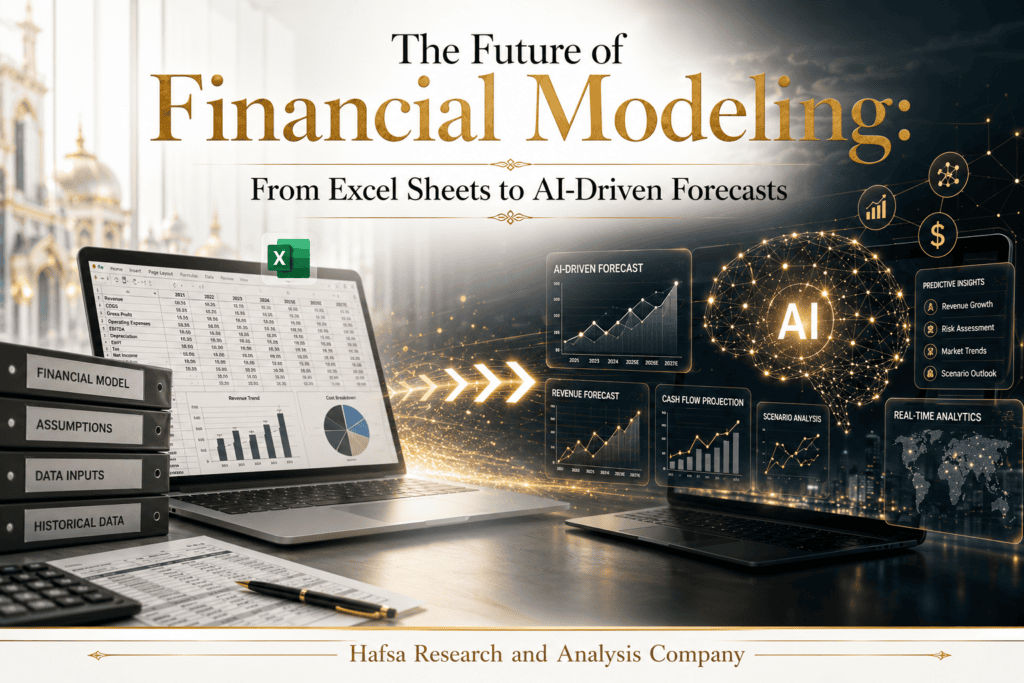
For decades, Excel was the financial world’s universal language. From valuation models to budget forecasts, everything was built cell by cell, formula by formula. That era is not ending—it is evolving.
The demands of today’s market—real-time decisions, macro shocks, and data complexity—require models that evolve faster than traditional spreadsheets alone can support. But the answer is not to abandon Excel for AI. It is to combine full human expertise on Excel, AI-augmented analysis, and human-led interpretation into a single integrated architecture.
The evidence supports this hybrid approach. Research from the University of Chicago Booth School of Business found that 78% of CFOs expect AI to have a significant impact on financial modeling within three years, yet only 23% trust AI outputs without human validation. The gap is not capability—it is governance and judgement.
Global leaders like JP Morgan, PwC, and Goldman Sachs have already proven the value of combining AI and human expertise. The question for growing firms and startups is how to access this same institutional-grade intelligence without losing human judgement.
Solution 1: Keep Human Expertise at the Foundation—Excel Remains Essential
The most sophisticated AI model is only as good as the assumptions it is built on. At Hafsa Financials, we design investor-grade financial models that integrate full human brain on Excel: models structured and tested manually by professionals with deep expertise in IFRS, business analysis, and financial risk assessment. Every assumption and formula is justified through rigorous audit-style validation.
This is not nostalgia. It is risk management. AI can process data, but it cannot determine whether a revenue growth assumption is commercially realistic. It cannot assess whether a lease classification reflects the economic substance of the arrangement. It cannot exercise professional scepticism.
Action step: Before deploying AI in any financial model, ensure the underlying Excel structure is sound. Document every assumption with a rationale. If you cannot explain why a formula exists, AI will not fix that gap—it will amplify it.
Solution 2: Use AI for What It Does Best—Large Data Interpretation and Anomaly Detection
AI assists in interpreting large data sets, refining assumptions, and generating automated insights. At Hafsa Financials, our team uses ChatGPT and Microsoft Copilot for data interpretation and commentary drafting—ensuring accuracy, speed, and clarity.
But the role is bounded. AI flags potential risk clusters; our analysts validate and contextualize them. AI generates predictive summaries; our financial analysts and ACCA professionals transform those insights into investor-grade commentary—strategic, contextual, and decision-ready.
Action step: Define the boundary between AI-generated output and human-reviewed output. For each model component, specify: what AI produces, what human review is required, and what documentation supports the final conclusion.
Solution 3: Combine Human Intuition with AI Pattern Recognition for Risk Assessment
We conduct business risk and financial risk assessments by combining human intuition with AI-driven pattern recognition. This dual approach ensures a balanced approach between automation and experience.
The failure mode of AI-only risk assessment is documented. In 2022, a fintech startup suffered a 15% loss in earnings when its AI model failed to anticipate inflationary shocks—no human analyst reviewed it. The model misinterpreted an anomaly as a trend.
The failure mode of human-only risk assessment is equally documented. Manual models can be slow, may miss trends hidden in large data sets, and are prone to fatigue and bias.
Action step: For every risk assessment, require two outputs: an AI-generated risk cluster map and a human-written contextual analysis. Where they diverge, investigate. The divergence is often where the most important insight lies.
Solution 4: Build Models That Are Investor-Ready, Dynamic, and Strategic
Hafsa Financials builds models to be:
- Investor-Ready: Fully audit-compliant and IFRS-aligned
- Dynamic: AI-updated forecasts based on real-time data
- Strategic: Contextualized through human commentary and insight
These three attributes are not independent. An investor-ready model without dynamic updating becomes stale. A dynamic model without strategic context becomes noise. A strategic model without audit compliance becomes a liability.
Action step: Assess your current models against these three criteria. If any is missing, the model is incomplete. For startups and growing firms, investor-ready does not mean complex—it means defensible. Every assumption must withstand scrutiny.
Solution 5: Design Implementation, Not Just Analysis
Beyond modeling, we design execution strategies—outlining how businesses can apply model findings to real-world decisions like expansion, cost reduction, or capital raising.
This is the step most financial models skip. A model that identifies a funding gap is useful. A model that identifies a funding gap, evaluates three financing structures, and recommends one based on covenant impact and cost of capital is strategic intelligence.
Action step: For your next major model, add an implementation section. What decisions does this model inform? What are the trade-offs between options? What would trigger a revision to the plan?
Executive Checklist: Hybrid Financial Modeling Readiness
Foundation:
- □ Excel models structured and validated by experienced professionals
- □ Every assumption documented with rationale
- □ IFRS and audit compliance verified
AI Augmentation:
- □ AI used for data interpretation, anomaly detection, and commentary drafting
- □ Boundaries defined between AI output and human review
- □ Documentation standards for AI-assisted conclusions
Human Interpretation:
- □ Risk assessments combine AI pattern recognition with human contextualization
- □ Investor-grade commentary written by qualified professionals
- □ Divergence between AI and human analysis investigated, not ignored
Strategic Output:
- □ Models are investor-ready, dynamic, and strategic
- □ Implementation strategies designed alongside analysis
- □ Scenario ranges and downside cases presented, not just point forecasts
Closing Thought
The future of finance is not automation alone—it is augmentation. AI handles data; humans handle direction. Together, they redefine what financial modeling truly means—transforming data into decisions and strategies into sustainable success.
The perfect model is not just built by machines. It is crafted by human expertise, enhanced with AI intelligence, and implemented through strategic foresight.
At Hafsa Financials, this synergy ensures every client receives a model that thinks like a machine but reasons like a human.
The question for every finance leader is direct: Is your model built to calculate—or built to decide?
Prepared by Hafsa Research and Analysis company