
By Mirza Founder and President HafsaAdivosrs and Solutions LLP
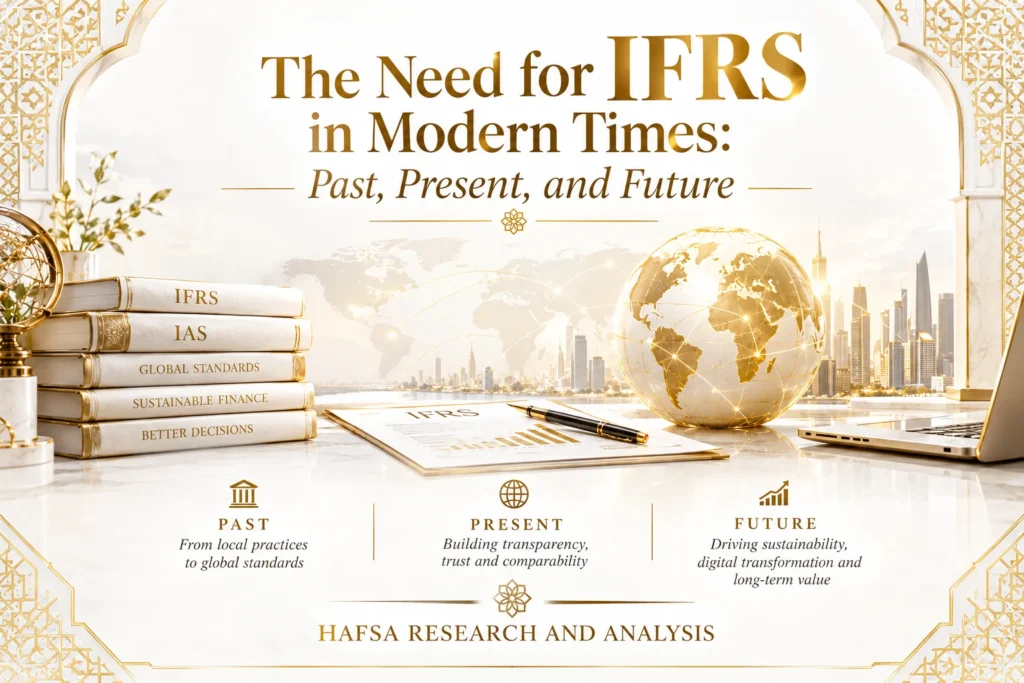
The Past, Fragmented Financial Realities
In earlier decades, financial reporting was a disjointed practice. Each nation applied its own accounting code, often disconnected from global reality.
For CEOs and CFOs, this created blind spots in financial analysis and made cross-border risk assessment nearly impossible.
A lack of standardized disclosure meant investors and acquirers were evaluating businesses through inconsistent lenses, one reason why valuations, mergers, and performance comparisons often led to misleading outcomes.
The Present, IFRS as the Framework for Modern Financial Intelligence
Today, IFRS (International Financial Reporting Standards) has transformed financial reporting from a compliance exercise into a strategic instrument.
It provides a uniform framework for financial and business analysis, ensuring that ratios, cash flows, and balance sheet insights reflect real performance, not accounting manipulation.
For CFOs, IFRS serves as the backbone for ratio analytics, from liquidity and solvency to profitability and valuation multiples, ensuring that key indicators are comparable across industries and regions.
For CEOs, it enhances decision-making by offering transparent financial intelligence. The insights derived from IFRS-based statements form the foundation of business strategy, investment decisions, and operational reforms.
For Investment Banks and M&A professionals, IFRS has become the language of risk-adjusted value. It allows more accurate assessment of goodwill, impairment, contingent liabilities, and acquisition-related costs, all critical to due diligence and deal pricing.
The Risk Perspective, IFRS as a Shield Against Financial Uncertainty
In a volatile market, financial risk assessment is the heartbeat of sustainable growth. IFRS mitigates risk through:
- Fair Value Measurement (IFRS 13): Ensures assets and liabilities are valued with transparency, minimizing exposure to inflated or hidden valuations.
- Expected Credit Loss Models (IFRS 9): Strengthens risk forecasting for financial assets, critical for banks, fintechs, and corporate treasuries.
- Revenue Recognition (IFRS 15): Aligns reported performance with real economic activity, reducing distortion in earnings analysis.
- Leases and Liabilities (IFRS 16): Brings off-balance-sheet obligations into clear view, improving debt ratio and leverage evaluations.
By aligning risk recognition with reality, IFRS enhances financial resilience and strategic foresight, something traditional local GAAPs rarely achieved.
The Analytical Angle, Bridging Business and Finance
In the modern boardroom, Business Analysis and Financial Analysis converge. IFRS facilitates that integration by providing:
- Consistency in Financial Ratios: Whether assessing liquidity, profitability, or capital structure, IFRS ensures comparability across borders.
- Risk-adjusted Performance Metrics: Accurate EBT, EBITDA, and EPS measurements that truly reflect operational efficiency.
- Enhanced Predictive Modeling: Reliable data for forecasting and scenario-based decision-making, vital for private equity, venture finance, and M&A deals.
With IFRS as the foundation, financial models become more credible, valuations more defensible, and business risks more quantifiable.
The Future, IFRS in the Age of AI and Digital Finance
As financial technology evolves, the next generation of IFRS integration will be driven by automation and analytics.
- AI-powered ratio analysis will flag financial anomalies before they become risks.
- IFRS-aligned data visualization will allow executives to translate numbers into insight.
- Digital assets, ESG, and sustainability will fall under new IFRS interpretations — making corporate transparency multidimensional.
For CEOs and CFOs, this evolution means one thing: decision-making powered by structured intelligence.
Final Thought
In every financial cycle, past, present, and future, one truth remains constant: credibility drives capital.
IFRS doesn’t just enhance reporting; it refines perception, strengthens trust, and anchors sustainable value creation.
In the hands of visionary leaders, it’s more than a standard, it’s a strategy.
Authored by:
Mirza Founder and President Hafsa Advisors and Solutions LLP